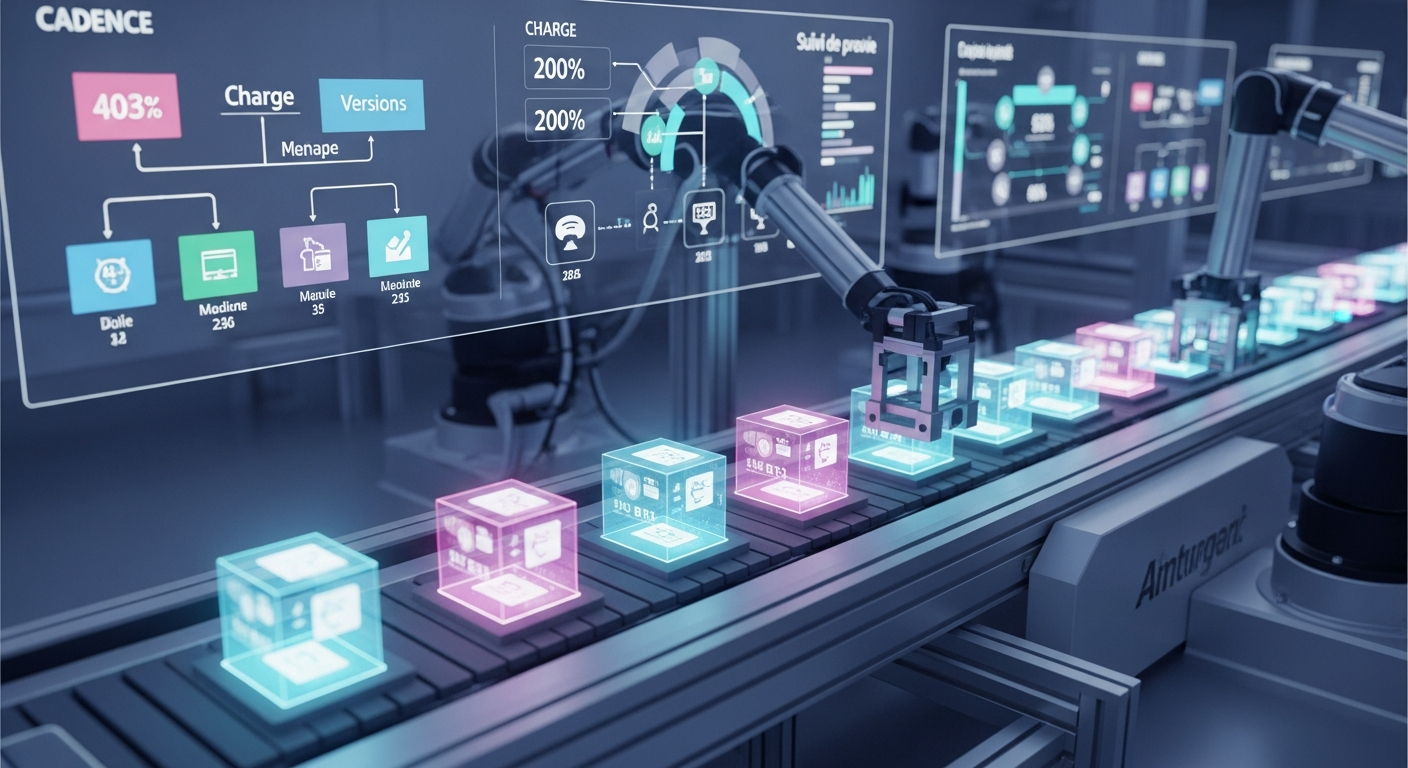
One module is fine. Two, we can manage. Ten? That starts to stretch things a bit. And then comes that very real moment when the team isn’t really talking “creative” anymore, or even “teaching” in the noble sense of the word. It’s talking throughput. Workload. Rework. Versions. And, pretty quickly, proof tracking.
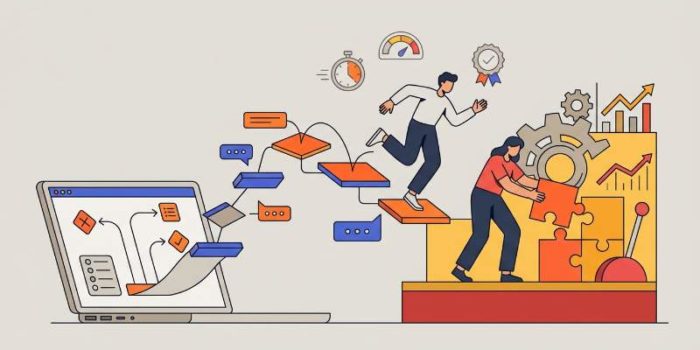
That’s often when Digital Learning changes its nature. You leave the logic of the beautiful object designed case by case, almost by hand, and move into something more structured, more robust too. The challenge is no longer just to make a good module, but to establish a production capability that holds up over time, that can absorb volume and that doesn’t derail quality at the first spike in demand.
In this landscape, VTS Editor, developed by Serious Factory, provides an operational answer to industrialize Digital Learning with VTS Editor (without development). The tool makes it possible to design role-play scenarios, gamified interactive modules, and serious games, then export them—particularly as SCORM—for broad distribution in an LMS. Put differently: it’s not just about producing more. It’s about producing faster, with fewer dependencies, without letting go of what really matters: real-world use cases, target skills, and practice gaps to correct.
The objective of this article is simple: lay out a clear path, from HR scoping to scaling up.
When demand rises, handcrafted work quickly shows its limits
Onboarding, compliance, safety, cybersecurity, management… requests don’t come in one by one anymore. They pile up. Training teams feel it every day: timelines stretch, standards blur, some modules are solid, others much less so. And as soon as a rule changes, a job evolves, or a process shifts, you have to put the work back on the table. Sometimes slightly. Sometimes at great expense.
The issue, fundamentally, isn’t only a question of workload. It quickly becomes structural.
Training too late directly exposes the company. Employees find themselves managing real situations without sufficient preparation. Training with disparate content creates something else—less visible, but no less problematic: uneven interpretations, diverging practices, blind spots. In safety or compliance, that kind of gap can be very costly.
Add to that incomplete traceability, tracking that’s difficult to consolidate, and an overly strong dependence on a few key profiles (developer, studio, external vendor), and you get the classic bottleneck. Except it’s no longer a one-off incident. It’s the system itself that’s stuck.
Conversely, industrialized production clearly changes the game. Timelines shorten. Updates stop being mini-projects in their own right. Quality becomes more stable. And, above all, you can start steering something other than the simple publishing of content.
Industrializing Digital Learning with VTS Editor does not mean making modules interchangeable
The word “industrialize” sometimes makes people tense up. You imagine cold content, standardized down to the bone, without nuance. In reality, it’s often a misunderstanding.
In Digital Learning, industrializing doesn’t mean smoothing out everything that gives an experience its value. It means organizing production so it’s reproducible, scalable, maintainable. In short: bringing order where it’s useful, and keeping freedom where it truly produces something.
What can be standardized without losing quality
The instructional structure can be stabilized without harm: a narrative framework, recurring interaction types, feedback rules, validation criteria, quality-control checkpoints, data to report back. All of this benefits from being consistent.
What must stay alive to match the field
Context, on the other hand, must stay alive. Situations change, characters too. Field wording, job constraints, day-to-day irritants: that’s what you need to preserve.
The real shift happens here: stop reinventing the skeleton for every need, and reuse a proven structure while adapting it to different realities. The same role-play format (brief, sequence, choice, consequence, debrief, validation) can work just as well for a management topic as for safety or compliance. The mechanism hardly changes. The reality on the ground, meanwhile, is constantly moving.
For whom, exactly, and to address what
The underlying question is fairly down-to-earth: how do you scale without losing control?
This topic first speaks to training managers. They’re often the ones who have to absorb more requests, without sacrificing quality or endlessly lengthening production times.
It also concerns HR leaders, especially when the stakes go beyond content distribution alone: securing onboarding, ensuring compliance, tracking learning paths, smoothing the employee experience, limiting risks.
And then there are instructional designers. The ones who want to produce more engaging, more realistic experiences, without getting blocked at every iteration by a technical tunnel or a dependency on development.
There’s certainly an informational dimension to all this. But the expectation is above all practical: identify a workable solution—here, VTS Editor—and see how to embed it in a broader system, with a deployment and steering logic.
Industrializing digital training production: start with scoping
It’s a classic reflex: you start by looking for the platform. It’s tempting because it’s concrete. But it’s also often the wrong starting point.
Serious industrialization doesn’t begin with a tool. It begins with clear objectives, assumed priorities, defined roles, and a few simple rules. The tool speeds up what was thought through beforehand. It doesn’t replace that phase.
Start with the right question
The first question isn’t: “how many modules do we need to produce?” Not at the start, anyway.
The real question looks more like this: what behavior must change, for which population, within what timeframe, and based on what proof?
As long as that point remains fuzzy, you enter a volume-for-volume’s-sake logic. You build. You feed a backlog. You check boxes. But you prove very little.
A few examples make the topic more concrete:
- In onboarding, you may be trying to reduce time-to-autonomy or errors in the first weeks.
- In compliance, the objective may be to reach 100% coverage of a given population within a specific timeframe, with proof to back it up.
- In safety, it’s often about strengthening reflexes: spot, decide, report.
- In management, the need may be to align practices around recurring situations: feedback, correction, delegation, tension management.
Only once this foundation is set can you prioritize intelligently.
Prioritize what truly deserves to be industrialized
Not all content justifies the same investment. And to put it simply: not all content is worth industrializing.
Three criteria are particularly useful:
- volume;
- criticality;
- update frequency.
The most relevant topics almost always come back: core onboarding, safety, cybersecurity, compliance, operational quality, customer relations, frontline management. Why those? Because they affect many people, carry real risk, and often require regular updates. That’s where the effort delivers the most value.
Governance: light, but clear
As soon as there are multiple stakeholders, ambiguity gets expensive. Delays, endless back-and-forth, approvals that drag on, inconsistent content… we’ve seen this movie.
No need to build a bureaucratic machine. But you do need to clarify who does what.
- The HR or L&D lead sets priorities, tracks indicators, sets the pace, and arbitrates the level of acceptable risk.
- Subject-matter experts don’t have to “write the module.” Their value lies elsewhere: surfacing real situations, frequent mistakes, sensitive cases, and the right decision criteria.
- Instructional designers turn that raw material into a learning experience: progression, choices, feedback, remediation.
The classic trap is asking the business to produce training. Instead, you should ask it to describe reality. Not “can you write a module?”, but “what gets stuck most often?”, “where do people get it wrong?”, “what distinguishes a good decision from a bad one?”.
That shift changes a lot of things.
Standardize just enough to save time (and avoid re-corrections)
You start to enter a true industrial logic when the same mistakes stop recurring from one project to the next.
For that, you need a framework. Not a 50-page document no one ever opens. Rather a short, clear, usable charter.
It can cover, for example:
- target durations by format;
- rules for wording feedback;
- minimum interactivity level;
- assessment principles;
- accessibility requirements.
Concretely, that can translate into very simple rules: brief, contextual feedback without unnecessary jargon; at least one meaningful decision every X minutes; subtitles available; clear instructions; an explicit passing threshold; remediation planned in case of difficulty.
This kind of framework avoids reopening the same debates over and over. And it stabilizes quality, even when more people join the production loop.
Why no-code helps industrialize Digital Learning
When you need to produce a few modules per year, a dependency on development can remain manageable. At several dozen, it becomes heavy. At several hundred, it ends up structuring the problem.
No-code isn’t magic. But it changes production capacity. Above all because it widens the circle of people who can design, test, fix, and maintain content without going through a technical cycle every time.
That’s precisely where VTS Editor fits in.
VTS Editor: industrialize Digital Learning with a no-code authoring tool
VTS Editor (Virtual Training Suite Editor) is a no-code authoring software offered by Serious Factory. It is used to create interactive e-learning modules, gamified learning paths, serious games, and, above all, realistic role-play scenarios via a visual interface.
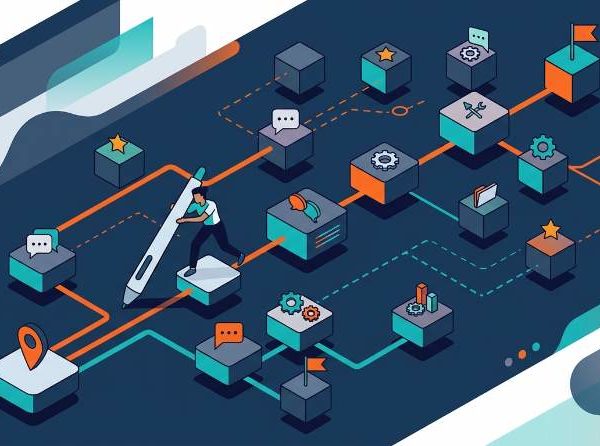
The logic is that of a scripting graph. You assemble blocks: dialogues, response choices, quizzes, scores, conditions, media. You connect the possible branches. You test. You fix. You republish. Then you export—particularly as SCORM—for integration into an LMS.
In the field, that meets very concrete needs:
- create branched learning paths without custom development;
- reuse an instructional structure across multiple modules;
- prototype quickly, then republish after adjustments;
- maintain multiple pieces of content without rebuilding the whole structure each time.
The gain isn’t only technical. It also affects how production is organized: less dependency, more responsiveness, and iterations that truly serve learning instead of weighing down the process.
To learn more about the product: Design software for gamified E-Learning modules made easy with AI.
Move beyond linear modules: bet on role-play scenarios
At scale, engagement doesn’t sustainably come from a more dynamic wrapper or a few extra animations. It can freshen things up, yes. But it’s not enough.
What truly holds attention is action: choice, observing, deciding, sometimes making mistakes, then understanding why.
A well-designed role-play scenario often aligns much more closely with real work than a linear module of the “next page, next page, final quiz” type.
Simple example: a managerial correction conversation
You set the context. A character speaks through a dialogue block. The learner chooses a response. That response may feed a score or a skill indicator. The character reacts: emotion, posture, tension, the scene’s progression. Explicit feedback sheds light on the effects of the choice. Then the sequence continues, or branches, until final validation.
This pattern replicates fairly easily: managerial feedback, conflict management, annual review, a delicate customer interaction… the wording changes, situations change, but the structure remains largely the same. And that is exactly what makes production scalable.
About the format: Interactive Role Play.
Gamification: useful, measurable, aligned with skills
Handing out points everywhere has never been enough to make a module more effective.
Gamification becomes interesting when it serves a clear instructional objective. In practice, it mainly plays three roles: provide immediate feedback, materialize progression, and organize remediation.
In VTS Editor, some mechanisms are particularly well suited to this logic:
- scores and skill levels;
- badges tied to real milestones;
- conditional branching based on results or certain path markers.
A learner can, for example, unlock targeted remediation after a critical mistake. Or access a more demanding variant if their decisions already show good mastery. You don’t “gamify” just to entertain. You structure learning.
On this topic: Gamified E-Learning Modules.
Adapt without exploding the number of versions
Many projects start out cleanly. Then variants arrive: countries, roles, sites, languages, local regulations. And that’s often when things get complicated.
Industrialization rarely goes off the rails when producing the first module. It goes off the rails when you have to adapt it.
Think in formats, not only in modules
A more solid approach is to build a small reference set of reusable formats.
For example:
- a “role-play scenario” format focused on decision-making and debrief;
- a “safety” format oriented around spotting, action, consequence;
- a “compliance” format built around the dilemma, the rule, and its justification;
- an “onboarding” format with guided discovery, micro-assessments, and resources.
These formats are more than simple graphic templates. They’re stabilized instructional structures. Once proven, they become a real internal asset. And that changes production speed.
Modularize rather than duplicate
Making twelve versions of the same module can sometimes seem faster at first. In reality, it’s a false good idea.
A modular architecture holds up much better over time: a shared core on one side, specific blocks on the other. Role, country, site, local regulation… each variation is isolated as much as possible.
The benefit appears immediately at the first major change. If a rule evolves, only the affected block needs to be revised. You avoid the domino effect that forces you to reopen the entire corpus.
Multilingual: centralize, without erasing the local
In international organizations, this is a sensitive topic. Centralize too much, and you lose local anchoring. Distribute too much, and each entity ends up living with its own version, more or less aligned with the rest.
The most sustainable approach often consists of stabilizing a source version, industrializing translation, then limiting local validation to what truly justifies it: sensitive vocabulary, cultural context, regulatory constraints.
The watch point is simple: avoid each country rebuilding the module on its own. That’s where everything disperses.
Deploy at scale: SCORM, LMS, traceability
Producing fast doesn’t help much if distribution remains makeshift. A library of content, on its own, doesn’t make a training system.
Industrializing also means deploying to the right audience, at the right time, in a traceable environment.
SCORM and LMS: the expected foundation
VTS Editor enables exporting scenarios in SCORM format, which makes it easier to integrate them into LMSs and track progress. For many organizations—especially on regulatory or sensitive topics—this isn’t a nice-to-have. It’s the minimum.
SCORM remains a reference standard for e-learning traceability, as described by the organization behind the standard: ADL, SCORM Resources.
The minimum expected is well known: knowing who took what, when, how far, with what result. At scale, however, that’s no longer enough.
For deployment and tracking: VTS Perform, plateforme LMS simple et efficace.
Measure something other than completion: steer acquisition
“The module is completed.” Great. But that says almost nothing about what was retained, understood, or applied.
Useful steering asks other questions: where do learners drop off? Which mistakes keep repeating? On which skills do weaknesses persist—by role, site, population? Where should the system be corrected?
That’s where well-designed scores, linked to explicit skills from the production phase onward, become useful on the HR and L&D side. They make it possible to steer more finely—less centered on exposure to content and more on what has been acquired.
VTS Perform can complement this setup by providing a more usable reading of performance and acquired skills across the deployed learning paths.
Industrialize digital training in a short loop (version, use, improvement)
Once content is launched, you need to avoid the “published, then forgotten” trap.
The healthiest operating model relies on a short cycle:
- deploy a first version;
- observe use, drop-offs, scores, friction points;
- fix what blocks or weakens learning;
- measure the effect of the fixes.
This loop changes the value of the system. Production no longer behaves like a static stock, but like a living system.
And the need for volume, meanwhile, doesn’t slow down. To put the market context in perspective, see for example the summary report: Global Market Insights, E-learning Market.
A simple method to industrialize Digital Learning with VTS Editor
To move from a scattered logic to truly scalable production with VTS Editor, a simple method is often enough. The hardest part isn’t defining it. It’s sticking to it.
Scope
Define HR objectives, target audiences, field constraints, and success criteria. If this foundation wobbles, the rest will spin its wheels.
Prioritize
Arbitrate with three filters: volume, risk, update frequency. Not everything deserves the same level of investment.
Stabilize
Formalize instructional formats, templates, media libraries, feedback types, and quality rules.
Produce
Build scenarios in VTS Editor, test fast, fix fast, republish fast. That’s where no-code shows its real usefulness.
Deploy
Export as SCORM and distribute in the LMS, or in the selected environment. The content must reach the right place, cleanly, with usable tracking.
Steer
Read results not only in terms of coverage or completion, but also from the standpoint of skills, difficulty areas, and remediation needs.
Frequently asked questions about industrializing Digital Learning with VTS Editor
Does industrializing Digital Learning mean giving up personalization?
No. As long as you don’t confuse standardization with uniformity. You standardize the mechanics (structure, interactions, quality control, measurement) to better adapt the real context: situations, dialogues, job constraints, field cases. In practice, it often improves useful personalization rather than reducing it.
How do you create interactive role-play scenarios without a developer?
With a no-code approach like VTS Editor’s, scenarios are built from blocks connected in a visual graph: dialogues, choices, quizzes, conditions, scores, media. Testing is immediate, and so are adjustments. Dependency on development drops sharply.
Which content best fits an industrialized logic?
Content with high volume, high risk, or frequent updates. Typically: core onboarding, safety, cybersecurity, compliance, operational quality, customer relations, frontline management.
Which indicators should you track to keep production under control?
You need to track both distribution indicators and learning indicators. On the deployment side: coverage, completion, timelines, audit proof. On the acquisition side: scores, performance by skill, drop-offs, gaps by population. The challenge isn’t only to observe consumption, but to inform decisions.
How do you avoid an explosion in the number of versions?
By building a solid source version, clearly separating the core from local variants, and explicitly governing adaptations. Modularization remains the best protection against drift. Each country, each role, or each site should not start from scratch.
What an industrialized approach enables, concretely
Ultimately, industrializing Digital Learning production isn’t about accelerating just to go faster. That would be a pretty thin objective.
The challenge lies elsewhere: building a sustainable capability. A capability to produce without depending on overly scarce resources. To distribute without makeshift workarounds. To update without starting over. To measure something other than completion rates. To improve what already exists instead of stacking more.
That’s the whole point of a well-thought-out combination: a clear HR strategy, a few solid standards, a no-code tool like VTS Editor to quickly design interactive and gamified scenarios, then reliable deployment supported by SCORM and the chosen tracking ecosystem.
When these building blocks align, digital training stops being a succession of isolated projects. It becomes a steerable system. Maintainable. And, yes, truly scalable.
To go further:
- Client Cases, discover their success with Virtual Training Suite
- The Benefits of Digital Learning Simulation
- Try Virtual Training Suite (free trial)
For useful academic resources on the effectiveness of interactive formats (simulation, feedback, active learning), you can also consult:
- Sitzmann, T. (2011). A meta-analytic examination of the instructional effectiveness of computer-based simulation games. Journal of Computer Assisted Learning.
- Van der Kleij, F. et al. (2012). Effects of feedback in computer-based learning environments: a meta-analysis. Review of Educational Research.
- Freeman, S. et al. (2014). Active learning increases student performance in science, engineering, and mathematics. Proceedings of the National Academy of Sciences.