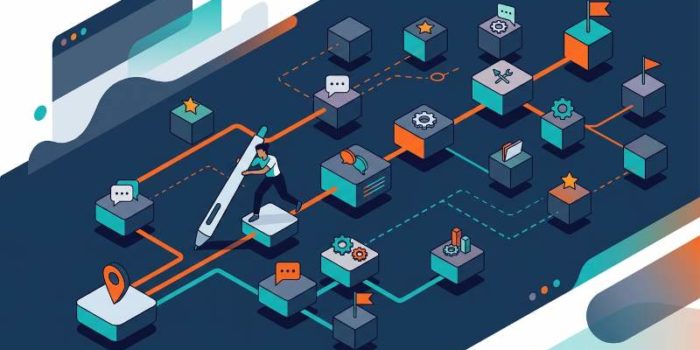
Designing branching scenarios requires a structured approach to decision paths. The goal is clear: sustain active engagement without causing cognitive overload. This non-linear instructional format adapts the narrative arc based on each decision made, confronting the learner with the direct operational outcomes of their choices. Instructional designers spend considerable time...

Designing interactive training programs requires staying closely aligned with day-to-day operational realities. After months of intensive production, instructional teams often launch a new course with high expectations. Yet initial feedback from subject matter experts is frequently critical: the training feels detached from real-world workflows, scenarios seem sanitized, and actual operational...
Most standard e-learning modules share a major flaw: they deliver purely sequential information. Employees mechanically click through successive screens, confined to the role of passive readers. In real workplace situations, handling complexity requires much more than theoretical memorization. Competence develops through active decision-making. Professionals must adapt to practical constraints, manage...
A branching e-learning scenario refers to a non-linear pedagogical architecture. Each learner decision triggers a specific consequence. This choice alters the rest of the learning path. To structure these modules effectively, instructional designers rely on precise flowcharts built around four core design patterns: the funnel, the fan, the remediation loop,...
Making e-learning training action-oriented refers to the instructional design process that transforms the simple dissemination of theoretical information into genuine practical training. To achieve this, you need to design interactive pathways integrating branching scenarios, professional role-play setups, and assessment based on behavioral choices rather than traditional declarative validation. An employee...
I regularly audit digital learning paths. I systematically observe the same flaw in their instructional design. Knowledge validation is often reduced to a strictly binary approach. The learner submits their choice and is immediately hit with a giant red cross. This signal is accompanied by the classic generic text stating...
Interactive Video vs. Classic E-Learning: Put an End to Passive Clicking Watching a ten-minute video behind a screen, even if it is beautifully produced, has never been enough to learn how to apply a critical safety procedure or handle an angry customer. At best, you retain two or three key...
At every back-to-school season, or almost, the same pattern comes back. We stack things up. Content, modules, topics, intentions too. In back-to-school e-learning training, this “just in case” strategy seems logical. In practice, it often produces the opposite: lots of material, little effect. The useful starting point is generally not...
Transforming a business objective into interactive learning is a recurring topic for training managers, HR managers, and instructional designers. You have a need expressed as a KPI (reduce errors, improve satisfaction, lower risks, speed up a process) and, sooner or later, one question comes back: how do you design an...
Creating an effective custom e-learning course seems like the best option when you want to train quickly, well, and with content tailored to the realities of the business. Yet many training managers, HR leaders, and instructional designers come to the same conclusion after delivery: the module is polished, it has...