


How to Detect Hesitations in Training to Measure Actual Skills?
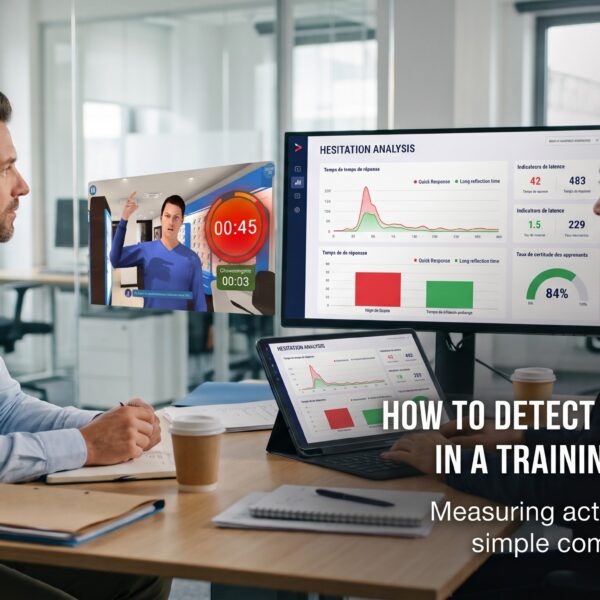
Detecting hesitations involves analyzing weak signals such as response latency, second-guessing, or backtracking within a learning module. The goal is to measure actual skills and assess operational confidence beyond mere test scores.
An employee can score 90% on an e-learning module, which looks like a clear success on paper. One week later, facing a customer on the job, that same employee hesitates and makes an error. This gap between theoretical validation and workplace execution represents a constant challenge for L&D leaders. It exposes the blind spot of standard metrics: a high completion rate often conceals critical points of doubt, the exact hesitation that precedes a costly mistake on the job.
This gap creates tangible operational risks: degraded service quality, compliance infractions, or missed sales opportunities. The priority is no longer verifying whether a learner “knows,” but confirming they can execute with confidence. Achieving that visibility requires tracking, analyzing, and interpreting micro-hesitations during the learning journey. These weak signals provide the clearest indicators to fix operational weaknesses before they trigger field errors, turning workplace training into a predictive performance driver.
Why Hesitation in Training Serves as a Key Performance Indicator
Fixating on final scores is a common mistake. An employee scoring 90% on an assessment appears to have mastered the material. That percentage says nothing about how they arrived at the answers. Cognitive research, including work by Asher Koriat and Rakefet Ackermann (Psychonomic Bulletin & Review, 2010), demonstrates that response time directly reflects confidence and answer stability. A fast, accurate choice reflects internalized competence; a prolonged response, even when correct, indicates heavy cognitive effort and underlying doubt. When an employee repeatedly backtracks, switches choices, or pauses excessively on core questions, their actual performance is much shakier than their score suggests. That hesitant path reveals fragile competence built on guesswork rather than clear mastery. Disregarding these signals validates theoretical knowledge while letting operational uncertainty take root.
From Training Hesitation to On-the-Job Errors
When handling a demanding client, a technical breakdown, or a high-stakes managerial decision, an employee brings that same uncertainty to the task. Hesitation seen during training easily turns into an on-the-job mistake: inconsistent service quality, missed safety steps, or lost sales due to lack of conviction. The objective is never to penalize the learner, but to turn hesitation into actionable diagnostic data. A pause might reflect thorough reflection, which is constructive, or paralysis from doubt, which introduces risk. Distinguishing between the two is essential to manage skills development effectively.
Concrete Behavioral Markers of Hesitation
These weak signals are measurable when using the proper diagnostic tools. Hesitation patterns typically include:
- Abnormally long response times during an interactive scenario, pointing to cognitive overload or missing execution reflexes.
- Frequent navigation back and forth across scenario branches, revealing a trial-and-error approach instead of a structured methodology.
- Changing an answer moments before final submission.
- Repeated replays of a single information screen, indicating weak knowledge retention.
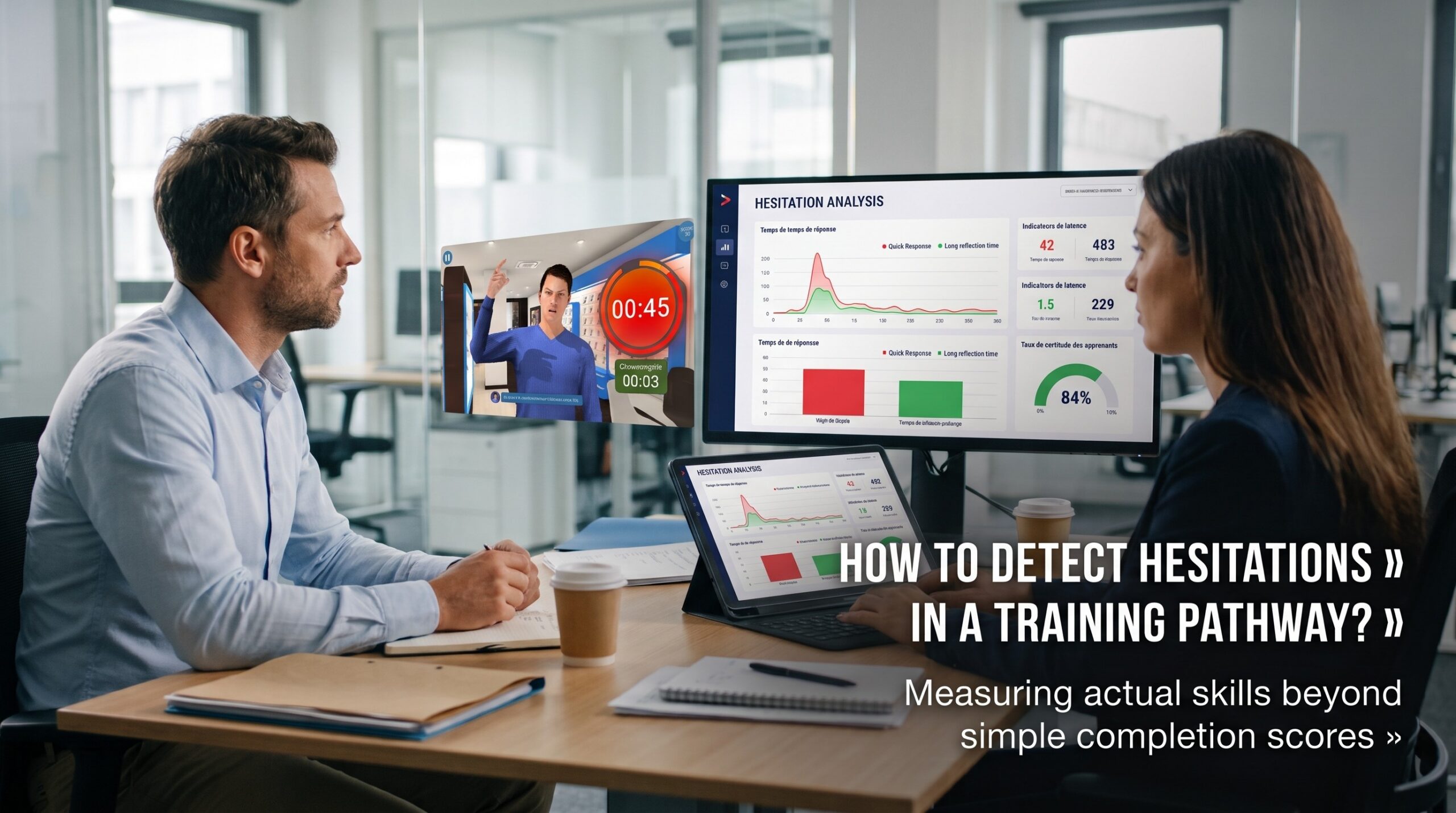
This is where an analytics and deployment platform like VTS Perform makes a practical difference. By capturing detailed learning data beyond basic SCORM scores, it maps not only what the learner answered, but where they hesitated. Trainers can spot specific friction points, understand where an employee’s decision-making broke down, and target their support accordingly.
The Shortcomings of Traditional LMS Platforms with Weak Signals
Most standard LMS platforms rely on an administrative view of workplace learning. They report typical SCORM completion metrics: progress status, final score, and total seat time. While adequate for basic compliance reporting, these metrics function as a black box. They hide the learner’s actual decision process. Knowing a sales rep achieved 75% on an objection handling module tells management very little. Did they handle pricing objections cleanly while struggling with competitor comparisons? Did they choose the right response immediately, or require three attempts?
Superficial reporting cannot differentiate an employee who executes a procedure smoothly from one who guesses correctly by luck. The resulting analysis remains incomplete, blocking targeted corrective coaching and leaving managers blind to operational risks. A standard LMS answers the administrative question: “Who completed which course?” A genuine skills management tool must answer an operational question: “On which specific skill is each employee truly ready to deliver in the field?”.
Building training that directly supports business results requires deeper analysis. The actionable value lies in dissecting the path taken, not just the score. This level of granular tracking separates a simple content delivery portal from a purpose-built skills management platform.
How VTS Perform Converts Hesitation Data into Practical Action
The Serious Factory ecosystem connects instructional design directly to learning analytics, turning raw session data into clear operational insights.
Step 1: Tagging Skills at the Design Stage with VTS Editor
Every interactive role-play built with the VTS Editor authoring tool is mapped to specific operational skills. Instructional designers go beyond building standard multiple-choice questions. They link each dialogue choice, user action, and decision point directly to explicit workplace competencies (such as “Active Listening,” “Product Technical Knowledge,” or “Negotiation Stance”). This structural mapping lays the groundwork for useful analytics. When VTS Perform collects activity data, it does not just log a click path: it qualifies every interaction against a defined skill. Choice selections, response latencies, and resource lookups are automatically tied to clear competencies.
Step 2: Analyzing Interactions for Clear Diagnostics
This method separates gaps in product knowledge from difficulty managing customer objections under pressure. The platform avoids generic feedback like “the learner failed.” Instead, it highlights: “the learner struggled with ‘pricing argumentation,’ taking three attempts and exceeding the benchmark response time by 40%.”
These findings appear on purpose-built dashboards designed for fast decision-making. Rather than burying training managers under generic vanity metrics, VTS Perform surfaces performance variances directly. Visual reports highlight individual and team-level uncertainty: an employee struggling on a specific operational step, a regional team hesitating on new pricing guidelines, or a compliance topic causing high error rates. With these diagnostics in hand, training teams can move away from one-size-fits-all refresher courses to deliver focused scenario adjustments, individual mentoring, or hands-on practice sessions.
Moving from Knowledge Testing to Performance Steering
Tracking hesitation shifts the focus of training management. The objective moves beyond testing recall on a final quiz toward evaluating execution readiness and operational certainty to measure actual skills. Every prolonged pause, backtracked decision, and hesitant click inside a practical scenario provides an advance signal of difficulties that will show up on the job. This approach shifts L&D from administrative tracking to qualitative skills development. The key question is no longer whether an employee “finished” their e-learning, but whether they are prepared to execute correctly.
This approach establishes the training department as a direct performance partner. Confirming that team members can apply skills smoothly protects the business value of training investments. That is the core role of VTS Perform: delivering the detailed interaction data needed to scale training, transforming raw activity logs into focused coaching and precise curriculum refinements. Business impact becomes direct, visible, and measurable. Instead of asking “How many people finished the module?”, managers can ask: “Where are our teams hesitating, and how do we correct it immediately?”.
Frequently Asked Questions
What constitutes a hesitation indicator in e-learning?
A hesitation indicator is a behavioral data point showing uncertainty or difficulty during a learning session. Common examples include response time on a scenario decision, repeated attempts before selecting the right option, or frequent navigation between scenario branches. These metrics reveal operational confidence and true proficiency beyond a test score.
Why is hesitation tracking more useful than basic SCORM reporting?
Basic SCORM tracking usually provides only completion status, total time spent, and a final score, leaving the cognitive process unseen. Hesitation tracking maps out how the learner made decisions, pinpoints friction points by skill, and explains why an error occurred, making targeted remediation possible.
How does VTS Perform highlight skill friction points?
VTS Perform gathers detailed interaction data from modules built in VTS Editor, where every decision point is mapped to an operational skill. The platform displays this data in clear dashboards, highlighting where learners pause, fail, or spend extra time, so trainers can intervene with targeted coaching.
Can hesitation analysis be used with all types of training content?
Hesitation analysis delivers the best results with decision-driven formats that require active problem-solving, such as interactive role-play scenarios, branching exercises, and serious games. Standard linear modules like basic slide decks or videos generate fewer decision signals. The Serious Factory suite is designed specifically to build and analyze these active, scenario-based learning experiences.