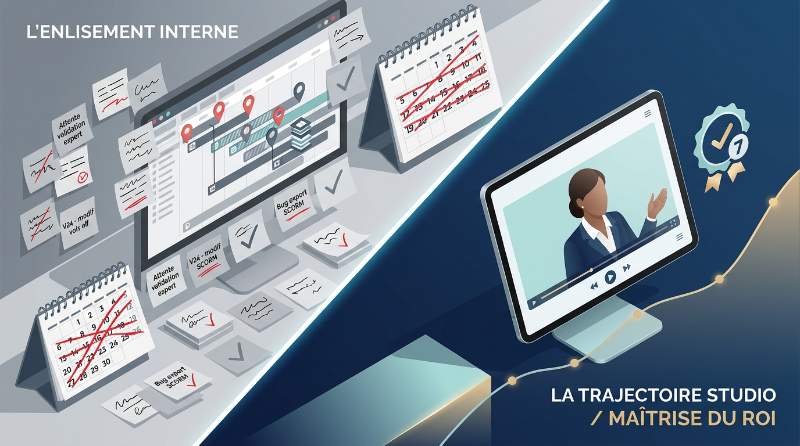
We have all been caught out at least once: assuming that building training modules in-house would save serious money. On paper, creating your own content makes perfect sense. In practice, this is precisely when budgets start to spiral. Between endless design cycles, unavailable subject matter experts, and last-minute technical adjustments, the actual e-learning production cost turns out to be much higher than anticipated.
Should you then do everything yourself or outsource the entire load? Working with a hybrid solution like SF Studio offers a third path. The key lies in looking at the actual numbers: how can you get custom interactive modules, delivered in 15 days, within a controlled budget? Let’s break down the math.
The Hidden Costs of In-House Creation: What Your Budgets Overlook
Beyond the Software: Time, the Ultimate Budget Eater
When calculating an in-house project budget, it is easy to focus solely on the price of the authoring tool license. This is a misleading calculation. To determine the actual cost of a module, you must factor in elements that are often invisible at the start:
- Your subject matter experts’ time: Every hour your sales director or safety engineer spends validating content or reviewing a script is an hour taken away from their core mission. This time carries a significant financial cost for the company.
- The array of additional tools: Very quickly, the basic license is no longer enough. You need to add subscriptions for video editing, stock graphics, synthetic voices, or artificial intelligence content generation tools.
- Testing phases: Ensuring the module runs smoothly on a field technician’s smartphone as well as an old office desktop requires substantial quality assurance testing time.
- Updates: A product changes, a process evolves, and you have to open the source files all over again to modify everything.
The Learning Curve of Interactive Storytelling
Equipping your teams with a professional authoring software like VTS Editor is an excellent choice for designing interactive role-plays and serious games independently. However, mastering interactive instructional design, building fluid decision trees, and integrating gamification requires a specific skill set.
Without initial support or training to structure your approach, your designers risk wasting time through trial and error. What could have been configured in two hours can easily take two days. This skill development ramp-up time leads to delayed projects and backlogs piling up on desks.
Technical Maintenance: The Invisible Trap
The module is delivered, and everyone is satisfied. Three months later, a browser update or a minor change on your learning platform freezes the SCORM file right in the middle of an assessment.
When you produce in-house, it is up to your designers to find the bug, fix the variable, and republish the content. This technical, time-consuming troubleshooting eats up valuable hours that should be spent creating new learning paths.
In-House vs. SF Studio: Real E-Learning Production Cost Analysis
Fixed Costs or Budget Flexibility?
Industry studies, such as the annual ISTF barometer (2024), point out that one hour of quality interactive training requires a significant time investment. According to the leading international association ATD (Association for Talent Development, 2020), designing a single hour of interactive e-learning can take between 90 and 140 hours of work depending on the level of complexity. If you multiply this time by the salaries of your designers and internal experts, your e-learning production costs skyrocket.
With SF Studio, the logic is reversed. You move from fixed overheads to flexible, controlled variable costs. Calculating the e-learning production cost means factoring in all these variables. There is no need to multiply software licenses or hire specialized technical profiles for a one-off project. You pay a clear flat fee per module, up to 7 times cheaper than working with a traditional agency.
Managing the Peak-and-Valley Resource Demand
In the training department, demand is rarely linear. You might face a massive rush with three product launches in the same month, followed by a quiet next quarter.
Managing this seasonality in-house is highly complex:
- During peak periods, your teams are overwhelmed, quality suffers, and deadlines are missed.
- During quiet periods, your software licenses and internal skills go underutilized.
Delegating to SF Studio provides flexibility. We absorb your peak workloads by producing and delivering your interactive videos in 15 days, protecting your teams from deliverable pressure.
| Criterion | Traditional In-House Production | Traditional Agency | SF Studio |
|---|---|---|---|
| Delivery Timeline | Variable, often several months depending on availability | 4 to 6 months | 15 days guaranteed |
| Total Cost | High and hard to predict (hidden costs) | High to very high | Flat rate (up to 85% savings) |
| Level of Interactivity | Often linear due to lack of time | High but premium-priced | High (branching scenarios and decision-making videos) |
| Maintenance | Managed in-house (time-consuming) | Billed for every change | Turnkey, proven SCORM deliverables |
How to Secure Your Training ROI
AI to Accelerate, Human Expertise to Guide
How do you slash costs without sacrificing instructional quality? Our approach is simple: we leverage AI to automate time-consuming or purely technical tasks, such as layout design, media editing, or basic integration. This allows us to produce content far faster than a traditional agency.
However, the core remains human-driven. Writing dialogues, refining decision-making scenarios, crafting meaningful feedback—all this is handled by our instructional designers. A machine does not understand your teams’ real-world constraints, operational challenges, or corporate culture.
A Simple 5-Step Co-Production Method
To keep training projects from dragging on, we use a standardized workflow:
- Source Material Scoping : You provide us with your existing resources, even if they are raw (a PowerPoint deck, a technical sheet, expert notes).
- Instructional Scripting : Our team writes the detailed script and designs the branching decision tree.
- Prototyping : You test a first interactive version to validate the tone and overall flow.
- Production and Voices : We finalize the video assets and integrate realistic voices.
- Delivery : You receive a package compliant with SCORM or xAPI standards, ready to deploy on your current platform or on our VTS Perform LMS.
Target Real-World Practice Over Passive Slide Reading
We have all taken a passive e-learning course where you just click ‘Next’ to scroll through blocks of text before answering a generic quiz. This is the fastest way to lose learner engagement and achieve zero impact on the job.
Decision-making video breaks this cycle. It places the learner directly in front of a concrete, real-life professional situation—such as handling a difficult customer complaint, applying a safety protocol on the shop floor, or leading a tense team meeting. The user makes decisions and immediately witnesses the consequences of their choices on video. This trial-and-error approach and instant feedback guarantee solid, long-term retention. To take this further, you can opt for the creation of custom e-learning modules fully tailored to your specific needs.
Frequently Asked Questions About Content Creation and Training Budgets
What is the average e-learning production cost with SF Studio?
A traditional digital learning agency typically charges between €15,000 and €30,000 for a complex interactive module. At SF Studio, we streamline these costs through our hybrid production model. This allows you to secure a custom, branching, interactive module for a highly optimized budget, starting at €2,990, delivered in just two weeks.
How do modules produced by SF Studio integrate with our LMS?
Seamlessly. We deliver standard packages such as SCORM or xAPI formats. They integrate and deploy without any technical friction on your existing platform or on our VTS Perform distribution platform for precise skills tracking.
What materials do you need to provide to launch a project?
There is no need to provide a pre-formulated instructional script or polished lesson plans. Your usual work documents are more than enough: an existing PowerPoint deck, a PDF procedure guide, or raw notes from one of your subject matter experts. Our designers handle the transformation of this raw material into an interactive and engaging learning path.