Why Traditional Online Learning Design Often Stalls
We all know the drill. January: scoping meeting. February: writing an 80-page storyboard in Word. March: endless email threads with the external agency. April: first developments… The result? When the project is finally rolled out in July, internal processes have already shifted. The content is obsolete before the first click. Most training managers and HR directors have lived through this at least once. It is slow, inertia is high, and the actual impact is weakened.
Yet, we can work differently. Believing it is impossible to create an e-learning module that is both high-performing and interactive in just two weeks is a misconception. Our SF Studio offering relies on a highly pragmatic hybrid production method. We divide design times by four. How? By combining AI tools (to draft the initial work and lay down the structure) with the expertise of our instructional designers. AI accelerates production; humans guarantee the impact and relevance of the content.
Industry figures, such as those published by the professional body Association for Talent Development (ATD), confirm this historic bottleneck: producing a single hour of traditional online training often requires between 100 and 150 hours of instructional design. This precious time is usually wasted in two main areas:
- Word or PowerPoint storyboards: static walls of text where nobody can actually visualize the final experience.
- Technical development: reinventing the wheel for every project, coding by hand, testing, and fixing bugs…
Meanwhile, operational teams are waiting. Take a sales force: if they are trained three months late on a strategic product, revenue is lost. If a new regulatory procedure takes a quarter to be deployed, the company takes unnecessary risks. Waiting six months to train your teams is no longer a viable option. To speed up, discover our practical tips on how to create an e-learning module quickly.
Interactive Video: Anything But Passive Watching
Let’s be clear: we are not talking about a basic linear video where the learner passively waits for the end while playing on their phone. In an interactive video, the employee is in control. They face a real-life situation, must make quick decisions, and each choice has direct consequences on the rest of the scenario. This is the principle of learning from mistakes, applied in a safe environment.
To produce this type of format at scale without blowing your budget, SF Studio splits tasks intelligently. Our algorithms handle generating the raw structure to eliminate repetitive tasks. Meanwhile, our instructional designers focus on what truly makes a difference: the tone of the dialogues, the accuracy of the feedback, and the credibility of the professional scenarios.
The Hybrid Method to Create an E-Learning Module in Record Time
Going fast just to deliver linear and boring content is pointless. To deliver on this 15-day promise without sacrificing instructional effectiveness, we rely on a very clear methodology.
Step one: we leverage your existing content. Your procedure PDFs, internal PowerPoints, or technical sheets are analyzed by our tools to extract a logical scenario structure. This avoids the blank-page syndrome and, crucially, spares your subject matter experts from having to rewrite everything from scratch. Our approach allows you to create an e-learning module of high quality without tying up your experts for months.
Step two: our instructional designers take over. They refine the scenario, add your company-specific terminology, adjust the difficulty of the choices, and write precise feedback. This collaborative approach delivers custom e-learning modules that truly resonate with your field teams.
A Concrete Example: The Decision-Making Video Scenario
To acquire a behavioral skill (the famous soft skills), reading slides is not enough. You need hands-on practice.
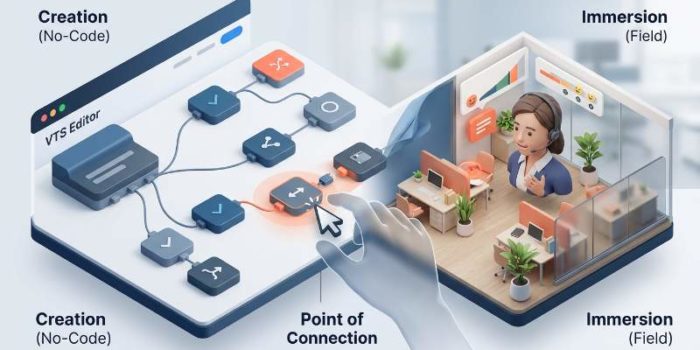
Imagine a customer service representative in a branch. An unhappy customer walks in, visibly annoyed, demanding an immediate refund of his account management fees. Instead of making the employee read a theoretical text on conflict resolution, we plunge them into an immersive video. The action pauses. Three options appear on the screen:
- Respond firmly by reminding them of the general terms and conditions.
- Accept the refund immediately to avoid a scene.
- Dig deeper to understand the issue and negotiate.
The representative clicks. The video resumes: the actor reacts live based on the chosen stance. Designed with our VTS Editor authoring software, these scenarios allow learners to test multiple approaches, learn from mistakes with zero real-world consequences, and build the right reflexes for their daily work.
Steps to Create an E-Learning Module with SF Studio
To industrialize production while maintaining quality, we follow a linear five-step process:
- Scoping and gathering: a quick meeting to align on operational objectives and collect your source documents (even in raw format).
- Accelerated scripting: fast-track creation of the instructional framework using our generation tools.
- Functional prototype: delivery of a first test version to validate the branching tree and pacing, before finalizing the visuals.
- Final production: integration of characters (avatars or real actors), sceneries, and your final text adjustments.
- SCORM delivery: export of the module, ready to be deployed on your training platform.
This workflow secures project milestones and divides your production timelines by 4.
Questions About Fast-Track Production? Find the Answers Here.
Visual Brand and Custom Sceneries: How Do We Adapt to Your Reality?
Realism is the key to getting learners fully engaged. Our studio creates custom sceneries for VTS Editor. Whether you need a production workshop, a reception desk, a supermarket aisle, or an executive office, we recreate your daily working environment to make the scenario completely credible.
How Does the SF Studio Budget Compare with a Traditional Agency?
Our hybrid process drastically reduces design costs compared to a traditional e-learning agency. By optimizing the graphic design and scripting phases, you minimize unnecessary production expenses while putting far fewer demands on your internal teams. To understand the financial optimization levers of your projects, read our article on how to master your e-learning costs.
Do Your Modules Work on Any LMS?
Yes, absolutely. Our deliverables are exported in SCORM (1.2 and 2004) and xAPI formats. They integrate seamlessly with all platforms on the market, including our skill tracking and management platform, VTS Perform.
And What About Measuring the Real Impact of the Training?
Forget traditional end-of-course questionnaires, which mostly evaluate immediate recall. Our decision-making videos track learners’ behavioral choices in detail. This allows you to analyze how your teams react to concrete, real-world situations. It provides a reliable indicator of skills actually acquired in the field.