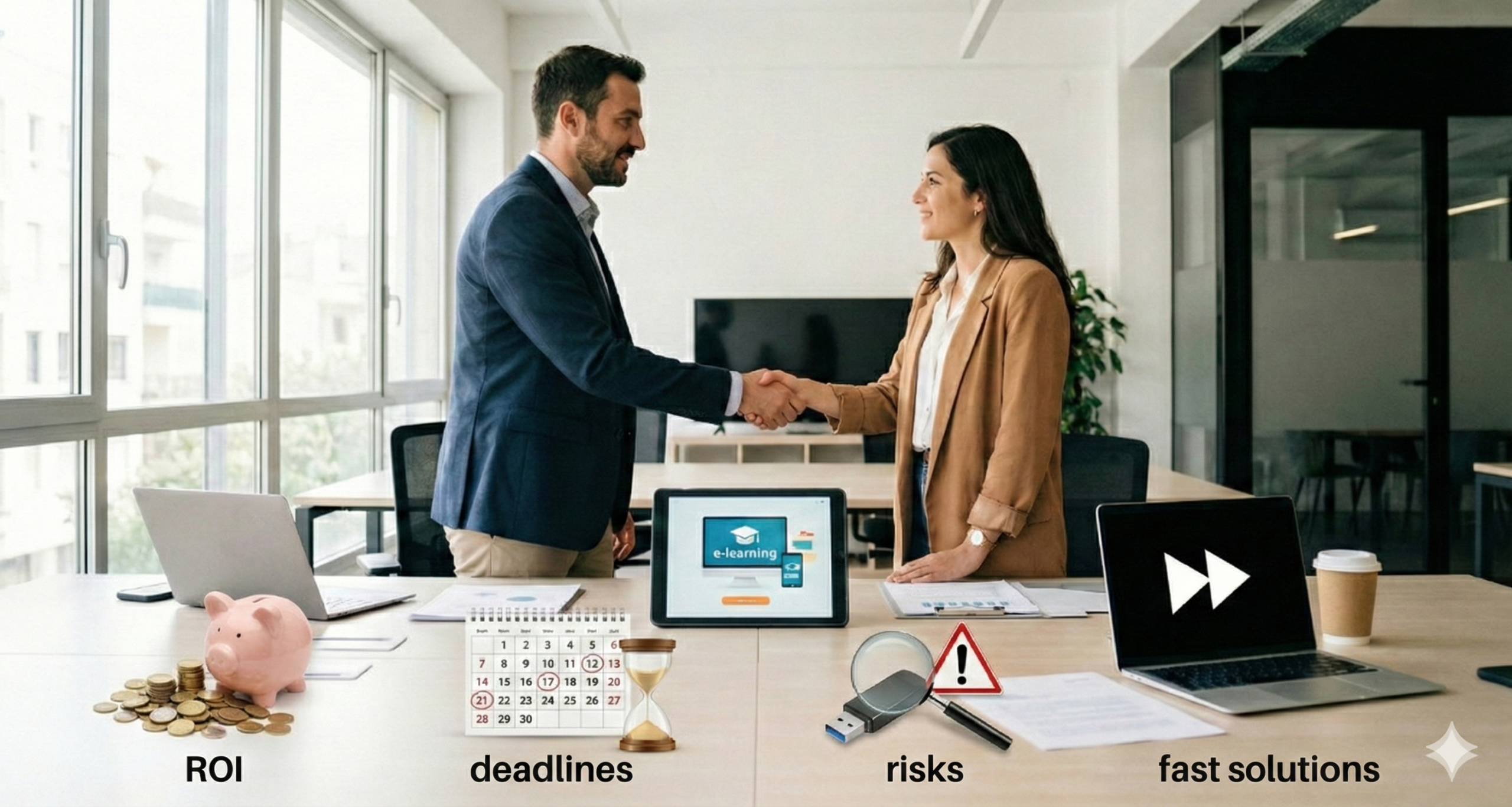
Outsourcing an e-learning module is often approached as a budget trade-off: “How much does a vendor cost compared to in-house production?” For a Training Manager, an HR Manager, or an instructional designer, the real question is more operational: “What do I really gain (money, time, quality, compliance, ability to roll out), and what do I risk (delays, rework, dependency, a module that can’t be used in the LMS)?”
An e-learning module isn’t a fixed deliverable. It’s a solution that must produce an observable effect: reduce field errors, speed up onboarding, secure a procedure, harmonize multi-site practices, or support a change. In these contexts, ROI isn’t limited to production cost. It plays out across four very concrete levers:
- Speed to go live (time-to-launch)
- Instructional effectiveness (transfer and application)
- Technical robustness (LMS compatibility, SCORM, multi-device)
- Ease of updating (ability to change without rebuilding everything)
This article helps answer the questions you ask yourself when you need to decide fast: how to estimate overall ROI, how much time to plan, what risks to anticipate, and what actions to launch as early as week 1 to cut timelines without sacrificing quality.
Outsourcing an e-learning module: what outsourcing really covers (scope, deliverables, deployment)
Outsourcing e-learning design: framing and measurable objectives
When you say “I want to outsource an e-learning module,” you could be talking about all or part of a value chain. Yet the first source of cost and timeline overrun is ambiguity about scope. In a quote, two vendors can show a similar budget while covering very different realities.
Outsourcing can include framing and instructional design. This is the phase where you clarify the audience, the context, the constraints, then transform a need into measurable learning objectives. Example: instead of “raise awareness about cybersecurity,” you aim for “be able to identify three signals of a phishing email and take the right action in the company’s information system.” The more concrete the objective is and the more it’s tied to behavior, the more evaluation becomes possible—and the more the ROI can be managed.
Outsourcing module production: storyboard, media, and integration into an authoring tool
Next comes scenario design: script, storyboard, choice of activities (quizzes, decisions, simulations), writing instructions and feedback. This is the heart of the module, and it’s also where late approvals cost the most. A sentence is quick to fix. A poorly structured learning path has to be redone.
Mediatization and production include design, media (illustrations, videos, sounds), voice-over, integration into the authoring tool, and tuning interactions. An internal instructional designer can sometimes provide a solid storyboard, but lack time or resources to make the module more engaging, visually consistent, or to industrialize production with a multi-module style guide.
Outsourcing deployment: SCORM, LMS testing, and tracking
Finally, deployment and compatibility cover SCORM export, testing on the target LMS, tracking (completion, score, time), and sometimes accessibility if your organization requires it.
A field reality: a “beautiful” module that fails SCORM UAT or behaves poorly on mobile immediately destroys ROI, because you pay twice (production + fixes + delay). To frame technical choices, you can rely on ADL’s official documentation (the historical reference for SCORM): SCORM 1.2 (ADL) and SCORM 2004 (ADL).
Why outsource an e-learning module (and when it works)
When your training team is overloaded
Motivations are rarely purely financial. They’re mostly tied to the ability to deliver and secure the outcome.
First very common case: your training team is overloaded. You have parallel projects (onboarding, compliance, transformation, internal tool rollouts), and e-learning production becomes a bottleneck. Outsourcing is primarily about buying production capacity with a cadence, milestones, and UAT.
When the date is fixed (audit, regulation, launch)
Second case: urgency. A date is imposed by an audit, a regulation, an organizational change, or a product launch. In these situations, ROI is first and foremost a time ROI. If the module arrives after the risk window, it becomes a secondary support rather than an operational lever.
When the instructional challenge requires realistic simulations
Third case: a quality requirement. When the field stakes are high, a linear module or a “narrated PowerPoint” is no longer enough. Business teams expect realism, decisions, consequences, contextualized feedback. Outsourcing truly works when it brings method, prototyping, solid scenario design, and a coherent learner experience.
A key point: governance. This means: who decides, who approves, and within what timeframe. Without that, the vendor waits, versions pile up, and the module slips week after week.
ROI: calculating what outsourcing an e-learning module (really) delivers
The right ROI indicators for a Training department
A credible ROI must speak to the Training department and to operations. To do that, link the module to an avoided cost, a reduced risk, or an improved performance.
Simple example: if your sales onboarding drops from 6 weeks to 4 weeks because new hires become autonomous faster on the pitch and the CRM process, you gain two weeks of productivity. That gain is often worth far more than the budget difference between in-house and a vendor.
On the cost side, don’t limit yourself to production cost. Also track:
- cost per learner (useful in large-scale rollouts),
- update cost (per version),
- support cost (tickets, reminders, catch-up sessions).
On the instructional effectiveness side, look for transfer indicators: fewer incidents, fewer non-compliances, a lower error rate on a task, an improved quality control score, or fewer support tickets. Completion rate is useful, but it mostly tells you whether the module is mandatory. It does not tell you whether the learner can perform.
To document impact, you can also rely on educational research on learning-by-doing and feedback (useful to justify scenarios and simulations). For example: Kluger & DeNisi (1996), meta-analysis on feedback interventions.
The total cost of an outsourced module: frequent omissions in quotes
The real cost isn’t only the vendor’s quote. It includes your internal time, and that time is often the invisible line item that drives the real budget up.
Costs that are often forgotten:
- Rework linked to unclear framing: you produce, then business teams say “this doesn’t match the field.”
- Availability of SMEs: without quick exchanges, the module is built on incomplete documents, then corrected late.
- Legal and technical constraints: media rights, fonts, music, IT security, network performance.
- Lifecycle cost: V1 is rarely the end; the question is updating.
In-house vs. vendor: when outsourcing becomes cost-effective
Outsourcing becomes cost-effective as soon as the cost of time and risk exceeds the savings achieved in-house. Concretely, it’s often cost-effective when the module requires a level of interactivity that demands real expertise and UAT that’s hard to maintain without a dedicated team.
If you produce simple modules very regularly, in-house can win—provided you have a solid production chain: templates, style guide, approval process, and stable SCORM export. But if you produce irregularly, the internal team loses time “getting back into it,” which degrades ROI.
The “time” ROI: often the most important
Time ROI is often the most important, because it impacts operational costs. Imagine a safety module for 2,000 people, required before a ramp-up in activity. If the module is delivered one month late, you compensate with manager briefings, reminders, and supervision time. The real cost of inaction often exceeds the difference between internal and external.
To make this ROI objective, estimate the cost of an avoided incident, the cost of an error, or the cost of one week of productivity in a critical role. Even a conservative estimate is enough to make the decision rational.
Timelines: how long does it take to outsource an e-learning module (and how to go faster)
Timelines by module type (microlearning, standard, simulation, gamified)
Timelines don’t depend only on duration in minutes, but above all on the level of interactivity, the number of approvals, and technical complexity. A 5-minute microlearning can take longer than a 15-minute module if it requires major clarification work, field examples, and specific media.
Common benchmarks (if source content is available and governance is clear):
- Well-scoped microlearning: 1 to 3 weeks
- Standard 10 to 20-minute module: 3 to 6 weeks
- Branching scenario simulation: 4 to 10 weeks
- Gamified module / light serious game: 6 to 12 weeks
The common point: the main bottleneck isn’t always the vendor, but internal approval.
The pipeline that accelerates: framing → storyboard → prototype → production → UAT
If you want to save time, your priority is to reduce uncertainty early. An approved storyboard accelerates everything, because it prevents producing on unstable foundations.
The prototype is a simple risk-reduction tool. Have a representative sequence produced with the level of interactivity, the visual style, the voice, and the pacing. Business teams approve something concrete, not intentions. This avoids “it’s not what we imagined” at the end of the project.
UAT should be anticipated. A Training Manager often saves time by requesting an LMS test environment from the start, and by defining a clear definition of done: what must be true to consider the module ready.
Causes of delays on the client side (and how to avoid them)
Delays often come from:
- SMEs being unavailable,
- unconsolidated feedback (multiple people, multiple files),
- outdated source content,
- IT constraints discovered too late,
- UAT done once at the very end.
Conversely, what works: planning short workshops, centralizing feedback, providing a minimal and validated content kit, involving IT from the framing stage, and approving by milestones.
Quick actions to reduce timelines starting week 1
As early as week 1, you can put simple actions in place that significantly reduce timelines:
- A one-page brief with measurable objectives, audience, LMS/SCORM constraints, and field examples
- A single approval decision-maker with a clear deadline (for example 72 business hours)
- An early prototype to lock down the experience and the level of interactivity
- A fast-delivered “MVP” version, then planned improvements
Risks: securing a project when you have an e-learning module built by a vendor
A “beautiful” module but not very useful: how to avoid the trap
A module can be aesthetically pleasing and fail instructionally. The most frequent symptom is the absence of useful activities: lots of information, few decisions, little feedback. Result: you “know,” but you don’t “do.”
To secure it, start from field errors. Example in customer service: instead of reciting a procedure, put the learner in front of an unhappy customer, offer three possible responses, then explain the consequences of each choice. This type of approach turns the module into practice, not just information delivery.
To support this choice with stakeholders, you can cite the literature on experiential learning and simulation: Kolb (2015), Experiential Learning (overview).
Vendor dependency: reversibility and source files
The module will evolve. If you can’t maintain it, your investment loses value. Dependency often comes from the lack of usable sources, unclear media rights, and production that is too “closed.”
The solution is to discuss reversibility from the start: source deliverables, minimal documentation, naming conventions, and update terms. Ask the question explicitly: “In six months, if a procedure changes, who changes what, how fast, and at what cost?”
Scope creep: staying in control
Scope creep happens through small successive improvements. Each request is “reasonable,” but the whole thing blows up timelines and budget. The solution isn’t to refuse any evolution, but to put a clear change process in place: what’s included, what isn’t, how a change is estimated, and who arbitrates.
Technical risks (LMS/SCORM, mobile, performance, accessibility)
A very concrete risk: the module works locally, but not on the LMS. Or it works on desktop, but not on mobile. Or completion tracking doesn’t report back.
The solution is simple but demanding: test early on the target LMS, with a SCORM checklist. Also clarify the expected standard. SCORM 1.2 is still very common, but some LMSs prefer SCORM 2004. Don’t approve a choice without checking your environment.
Internal governance that’s too heavy: avoiding endless approvals
The invisible risk is organizational: too many approvers, no consolidation, no arbitration. Lightweight governance accelerates ROI. You can secure it by appointing one approval owner, imposing a single feedback format, and approving in batches rather than at the end of the project.
Checklist before signing to outsource an e-learning module (10 questions)
- Learning objectives: what expected behaviors, observable in the field?
- Audience: who is the audience, what prerequisites, what uses and what devices (PC/mobile)?
- Module type: what level of interactivity is necessary (and not just “desired”)?
- Source content: is it up to date, approved, and concrete enough (exceptions, frequent errors, success criteria)?
- Timelines: what go-live date and what milestones (storyboard, prototype, batches)?
- Governance: who approves, within what timeframe, and how is feedback consolidated?
- Technical: what LMS, what SCORM standard, what IT constraints, what authorized browsers?
- Quality: what definition of done (instructional design, UX, performance, accessibility, UAT)?
- Reversibility: what source files will be delivered, what media rights, what documentation, what update plan?
- Deployment: what impact KPIs and what improvement plan (V1 then iterations)?
Choosing between outsourcing, insourcing, or a hybrid model
When to outsource (timeline, interactivity, LMS UAT)
Outsourcing is often relevant when you have a timeline challenge, a need for instructional quality (interactivity, scenarios), or a strong technical requirement (SCORM/LMS UAT, multi-device).
When to insource (regular production and simple content)
Insourcing is relevant when you have regular production, simple content, and a structured team (tools, templates, process, testing).
Why the hybrid model is often the most cost-effective
Hybrid is often the best compromise: outsource the design and V1 to secure the architecture, then insource part of the updates or variations to reduce long-term cost.
Serious Factory resources to move fast (without losing autonomy)
- VTS Editor authoring tool: easily design gamified e-learning modules
- Service: create a custom e-learning module (interactive and ROI-driven)
- Client cases: examples of projects and results
- Get a free prototype to quickly validate the format
If your goal is to move fast while keeping control over updates, the right reflex is to clarify the checklist above, then choose an approach: outsource a robust V1, and secure maintainability (sources, rights, process) to preserve your ROI over time.
Key phrase (reminder): outsource e-learning module