Let’s be blunt.
In 2026, the price of a truly custom e-learning module—one that’s actually designed for your organization, not just recolored—most often falls between €10,000 and €80,000. Below that, around €5,000, you’re generally looking at a short, fairly simple format, with few interactions and limited customization. Above €100,000, you move into another league: complex simulation, many branches, heavy constraints, denser production, longer validation cycles.
And there’s a classic trap: trying to reduce the budget to a “price per minute.” It’s tempting because it’s simple. The problem is that it oversimplifies.
Because what drives the cost of a module isn’t only its duration. It’s mostly everything it includes: instructional design, level of interactivity, richness of feedback, media, language versions, accessibility, compliance requirements, LMS compatibility, tracking logic. A module can look very simple on screen and be, behind the scenes, very demanding to produce.
Price of a custom e-learning module in 2026: useful ranges
To compare quotes, you need benchmarks.
- Simple module: about €5,000 to €15,000
Clear content, clean structure, limited interactions, standard SCORM export. - Standard module: around €10,000 to €30,000
You move into real scenario design, with more interactive screens, feedback, and some media. - Advanced module: between €30,000 and €80,000
Branching, scoring, remediation, reinforced UAT, sometimes multiple languages. - Ambitious simulation or serious game: €80,000 and up
Non-linear learning path, rich structure, more nuanced narrative, heavier testing, often with strong business or regulatory requirements.
What widens the gaps between these categories isn’t just design. The real difference comes from hidden complexity. As soon as the learning path offers multiple choices with different consequences, the workload increases fast: writing, integration, branch consistency, QA, and especially QA.
“Custom” doesn’t always mean the same thing
The term is everywhere. And it’s reassuring. But it doesn’t always cover the same reality.
In the strict sense, a custom module starts from your reality: your jobs, your tools, your procedures, your risks, your wording, your internal culture. The learner isn’t in a generic setting—they’re in a world that feels familiar.
In practice, many offers described as “custom” are closer to light personalization: logo, color palette, homepage, two or three tailored examples. It’s useful, but it’s not the same thing.
- Off-the-shelf: ready-to-use content, quick to roll out, more economical, little contextualization
- Personalized: an existing base partially adapted to your environment
- Custom: content designed from the start based on your real-life situations
The nuance becomes very concrete as soon as you’re aiming for more than simple information transfer. When the goal is to change reflexes, behaviors, or posture (management, sales, safety, customer relationship), the level of realism really changes the game.
Factors that affect the price of a custom e-learning module
Two modules of similar duration can have very different budgets. It’s common, and it’s not necessarily a sign that a provider is “overcharging.”
The differences almost always come from the same topics. Some are obvious right away. Others show up late—sometimes at the worst possible time.
Module duration: important, but architecture often matters more
The reflex is logical: the longer it is, the more expensive it is. Yes—but not always in the proportion you’d expect.
The key question is often this: do you need to produce one single block, or a series of micro-modules?
A long linear module can cost less upfront, then become painful to maintain. A small change may require reopening the whole package, rerunning tests, republishing, redeploying. Conversely, a journey broken into shorter elements sometimes requires more framing effort, but makes updates much easier.
For regulatory topics, if rules change regularly, it’s better to isolate the parts that are likely to evolve. Otherwise, every change becomes a mini-project.
Interactivity and branching: where the budget flips
A module that informs almost always costs less than a module that trains learners to make decisions. And a module that assesses—or even certifies—adds another layer of constraints.
A classic quiz is relatively simple to produce: writing, integration, feedback, progression. A scenario-based exercise requires something else: credible choices, coherent consequences, useful feedback, continuity even when the learner gets it wrong.
That’s why decision trees are expensive: they don’t add up—they multiply.
- on one side, ten single-choice questions;
- on the other, a managerial interview simulation with eight key decisions, multiple possible outcomes, a competency-based score, and contextualized feedback.
The second format is no longer an enhanced questionnaire—it’s a scripted experience.
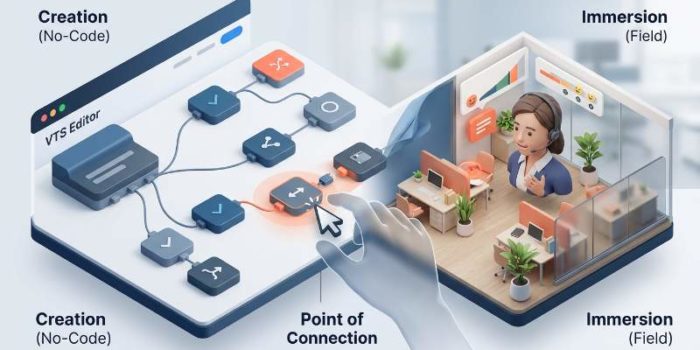
By the way, some authoring tools make it possible to industrialize part of this logic. At Serious Factory, VTS Editor was designed to create realistic, gamified learning paths without custom development, using a visual block-based logic (dialogues, choices, conditions, score, variables) and an LMS-compatible SCORM export.
Media (video, voice-over, illustrations): more impact, sometimes less flexibility
Video, voice-over, illustrations, animations: all of that can increase impact. But there’s a downside that’s often underestimated.
Video is excellent for showing a posture, a gesture, a situation. But it can become outdated quickly (UI, process, equipment).
Voice-over locks in the text. Every sentence must be approved, recorded, edited, synchronized. When content evolves—even slightly—pickups cost more. And in multilingual projects, it grows very quickly.
AI can speed up certain steps (outline, dialog variants, initial translation), but it doesn’t replace subject-matter work or instructional design work. The most effective approach is often: generate a base, then seriously rework it to match real-life conditions.
SCORM, LMS, accessibility, GDPR: the costs that show up at the end
This is a classic one.
A SCORM export doesn’t guarantee smooth integration into every LMS. Platforms don’t all behave the same way. Score, completion, resume, attempts, pass conditions—everything requires real testing, and sometimes adjustments.
Same for accessibility: it’s not only about contrast. Keyboard navigation, reading order, text alternatives, subtitles, understanding interactions, clarity of instructions. If these requirements come late, rework can be heavy.
On the GDPR side, as soon as data is tracked or stored—even indirectly—you need to clarify the scope: what, where, for how long, and for what purpose. To frame these topics correctly, you can rely on CNIL resources: GDPR: what is it about?.
A good habit is to set the tracking, completion, and success rules from the start. It’s not the “sexiest” part, but it’s one of the best ways to avoid extra costs.
Multilingual: it’s never just “translating the text”
Translation is only the first step. Then you need proofreading, local validation, adapting certain examples, sometimes revisiting visuals, screenshots, and business phrasing. If voice-over is planned, it must be recorded in every language. And you need to redo UAT for each version.
The most important point is time: every update will need to be replicated across all languages. Many budgets underestimate this effect at 12 or 24 months, when that’s often where the total cost is decided.
Which format should you choose based on your need (and your budget)?
The right question isn’t to produce “the most beautiful module possible.” You need a proportional format: solid enough to create a business impact, without becoming heavy to build or expensive to maintain.
Off-the-shelf: sometimes the best option
When the topic is stable, fairly generic, and not highly dependent on your internal context, off-the-shelf remains a strong option. Cybersecurity awareness, prevention reminders, regulatory fundamentals: on these themes, custom isn’t always the best investment.
However, a standard module can gain a lot from a very concrete internal addition: “Yes, but how do we do it here?”. A few targeted minutes on your tools, your contacts, your procedures can create a real jump in usefulness.
Well-scoped custom: often the best price/impact balance
In many cases, it’s the right compromise.
You get real contextualization, credible situations, useful interactivity—without tipping into an overly open-ended project. This format works very well for onboarding, customer relations, managerial posture, sales, or safety.
For companies planning several modules per year, this is often healthier than an ultra-ambitious project concentrated into a single deliverable. And depending on internal resources, a tool like VTS Editor can make it possible to bring part of the production in-house, then reduce dependency on an agency for future updates. To see concrete examples, you can check out our case studies.
Custom with an agency: sometimes necessary, needs framing
In some cases, an agency is the obvious choice: critical business stakes, strong regulatory requirements, advanced art direction, a large diversity of cases, high expectations for narrative or polish.
In these situations, full custom is often justified, but it requires clear project steering (otherwise drift comes as much from approvals as from production).
- clearly stated objectives
- explicit non-objectives
- a short prototype approved early
- simple validation governance
- a defined number of cycles
- an anticipated maintenance strategy
Estimating a budget: a simple method to frame a quote
You don’t need to be a digital learning expert to request a serious estimate. But you do need to reduce uncertainty, because uncertainty almost always ends up being paid for somewhere.
Before contacting a provider, clarify these points:
- Main purpose: inform, train, or certify
- Target audience: roles, volume, countries, level
- Format: short micro-module, series, longer learning path
- Level of interactivity: quiz, case study, branches, simulation
- Desired media: simple, premium, video, voice-over
- Degree of contextualization: branding, vocabulary, business situations
- Expected deployment: SCORM, LMS, tracking rules
- Constraints: accessibility, GDPR, compliance
- Languages: how many, with what validation, with or without audio
- Maintenance: update frequency, versioning, ownership
Not everything needs to be frozen from the start. But distinguishing what’s mandatory from what’s merely desirable already changes the quality of quotes a lot.
Frequently asked questions about the price of a custom e-learning module in 2026
What budget for 15 minutes, and what is the price of a custom e-learning module in 2026 for that format?
For 15 minutes, budgets are very often between €8,000 and €30,000.
The lower range generally corresponds to an informative module, well built, with a few interactions. The upper range comes quickly as soon as you add scenario-based practice, branching, contextualized feedback, scoring, or media that is more expensive to produce and maintain.
What makes a quote increase very quickly?
Four factors come up constantly:
- non-linearity, i.e., branches
- voice-over, especially multilingual
- accessibility or compliance constraints added late
- numerous, changing, or poorly framed validations
Most often, it’s not a single decision that blows up the budget—it’s the accumulation.
Is custom necessarily more expensive than off-the-shelf?
Upfront, yes, in most cases.
But if you think in terms of total cost, the answer becomes less clear-cut. A custom module can increase engagement, reinforce adoption, reduce on-the-job errors, or limit certain risks. In that case, the calculation doesn’t come down to the initial production cost.
On the impact of interactive formats and engagement, you can consult this widely cited synthesis work:
Hamari, Koivisto & Sarsa (2014), “Does Gamification Work?” (Computers & Education).
Is voice-over essential?
No.
It can be relevant to support attention, help certain audiences, reinforce scenario-based practice, or improve accessibility. But it makes updates heavier. A common compromise is to reserve audio for important instructions and key moments, and leave the rest for reading.
How can you reduce costs without losing effectiveness?
By targeting better.
It’s often more effective to focus interactivity on decision moments rather than trying to animate every screen. Breaking content into micro-modules helps with maintenance. Same logic for media: better a few, well-chosen elements than lots of scattered effects.
And you need to frame deployment, validation, and multilingual rules early.
Custom e-learning module price 2026: the real question behind the budget
Deep down, the question isn’t only “how much does it cost?” It’s rather: how much do you need to invest to produce a concrete change in the field?
A realistic budget therefore starts from the objective: inform, train, or certify. Then come the choices of format, interactivity, media, deployment. And one point is too often forgotten: maintainability at 12, 24, or 36 months.
The custom e-learning module price 2026 is neither “expensive” nor “cheap” in absolute terms. It’s proportional—or not—to the expected effect.
To go further, you can also consult:
- Interactive role plays
- Gamified e-learning modules
- High-Quality, Customized E-Learning Courses
- VTS Editor subscriptions
Useful sources:
- SCORM, reference documentation (ADL Initiative): https://adlnet.gov/
- RGAA reference framework, digital accessibility (DINUM): https://www.numerique.gouv.fr/publications/rgaa-accessibilite/
- Literature review on the effectiveness of serious games: Boyle et al. (2016), “An update to the systematic literature review of empirical evidence of the impacts and outcomes of computer games and serious games” (Computers in Human Behavior)