Buying or Producing an E‑Learning Module: How to Make the Right Choice in 2026?
In 2026, the learning function is caught in a vise. On one side, executive management demands proof of business impact, cost reduction, and time to competence. On the other, L&D, instructional design, and HR teams have to deal with very extensive e‑learning catalogs, increasingly powerful authoring tools, and business units who want “something concrete” and “tailor‑made.”
In the middle, one question keeps coming up in learning committees: Should we buy “off‑the‑shelf” e‑learning modules or invest in a custom e‑learning module?
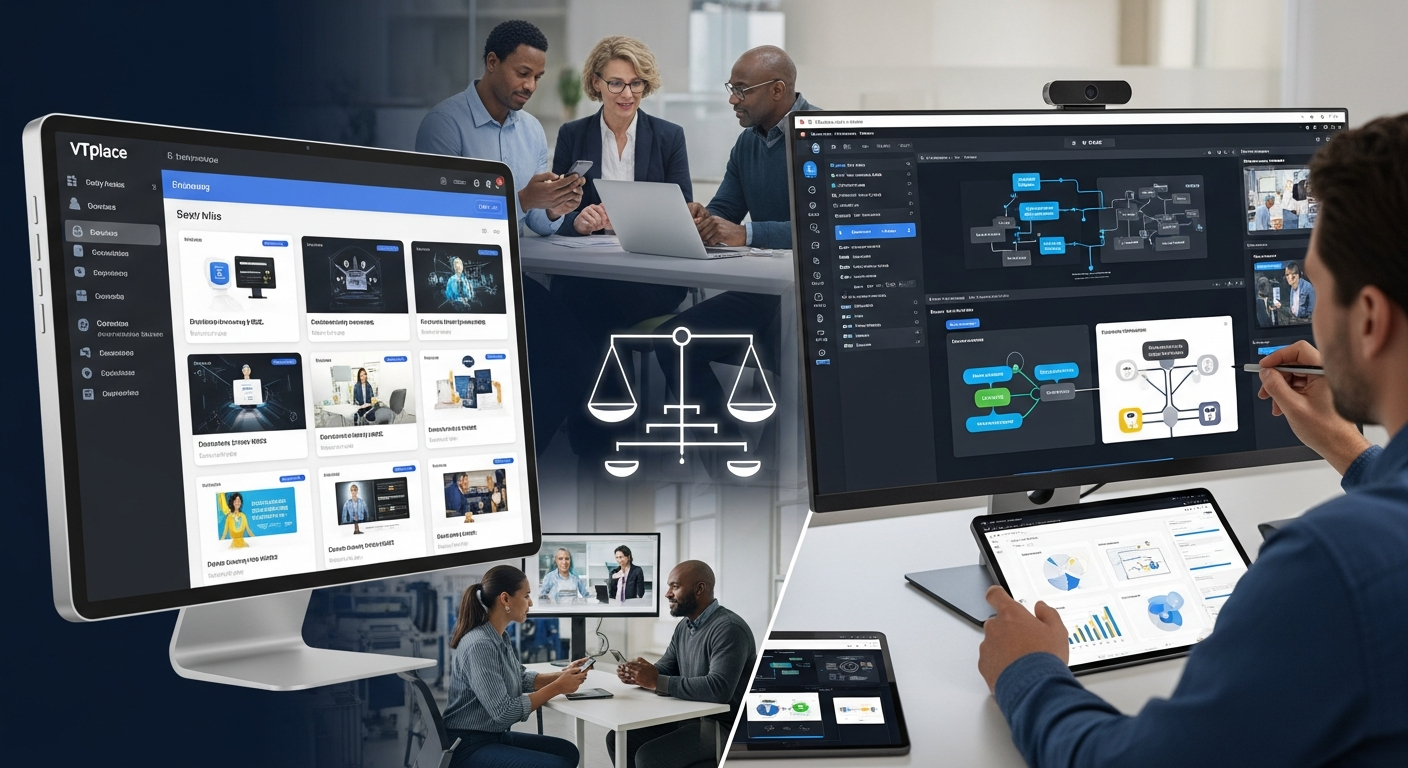
This question seems simple, but in practice it blocks many budget decisions: should you invest in an authoring tool like VTS Editor, sign recurring budgets with external agencies, or capitalize on ready‑to‑use catalogs via a platform like VTPlace?
The goal of this article is to offer a useful method for L&D managers, instructional designers, and HR leaders in order to:
- Clarify the situations where buying is relevant
- Identify when custom development becomes indispensable
- Build an intelligent mix between buying, in‑house production, and outsourcing, relying on VTPlace and on an authoring tool like VTS Editor
- Decide when a custom e‑learning module is the best investment
For an overview of our immersive solutions, you can also visit the page Revolutionize your E-Learning strategy with Serious Factory.
1. Before Buying or Producing an E‑Learning Module: Clarify Needs, Use Cases, and Constraints
Before you look at any catalog or brief a provider, the first question to ask is not “Which module are we going to use?” but “What do we really need for behaviors to change in the field?”
A successful e‑learning project almost always starts with a pedagogical and business scoping phase. Without this step, you risk buying a brilliant but useless module, or launching an in‑house production that fizzles out because of a lack of clear vision.
Clarify the Learning Objective and the Required Level of Customization
To decide between buying and producing, start by classifying your projects into three main families. This simple typology will help you answer questions you are probably already asking yourself: “Do I really need custom work for this topic?” “How far do we need to contextualize?”
Generic Awareness: When Customization Isn’t Useful
Here, the goal is to inform, warn, and disseminate a consistent message on a large scale. You are not trying to radically transform practices, but to instill basic reflexes and protect your organization on cross‑functional topics.
A few concrete examples you often encounter:
- GDPR for all employees
- Cybersecurity awareness
- Prevention of harassment or discrimination
- Eco‑gestures or basic CSR
In these cases, the content is largely shareable across companies. The risk of misalignment with your context is relatively low. This is the ideal playing field for off‑the‑shelf modules, easily accessible on a platform like VTPlace.
Studies on online learning also show that for standardized content (compliance, prevention, etc.), well‑designed standard modules produce results comparable to custom content in terms of basic knowledge (academic source).
Upskilling in Job‑Specific Competencies: The Realm of the Personalized E‑Learning Module
Here, you move away from purely generic content. You need to support real professional tasks:
- Using a CRM specific to your sales network
- Applying a sales methodology unique to your company
- Diagnosing a breakdown on equipment only your technicians operate
You are entering a “hybrid” zone where:
- Part of the content is generic (sales principles, basic maintenance concepts, etc.)
- Another part absolutely has to be contextualized to your processes, tools, and vocabulary
This is typically the area where a buy + produce mix becomes optimal. You might, for example, buy a module on sales fundamentals, then develop interactive scenarios with VTS Editor based on your own scripts, customer objections, and field cases. VTPlace then serves as a reservoir of content and resources that you enhance with custom material.
To illustrate this type of approach, you can explore the Novartis case, which implemented an immersive medical visit simulator in e‑learning: Novartis – Customer Case.
Behavior Change, Culture, and Advanced Soft Skills
This is the most sensitive area for an L&D manager or HR leader, because these are often the programs that are visible to the Executive Committee and tied to your strategic priorities:
- Rolling out a customer‑centric culture
- Transforming middle management
- Supporting a merger by working on collaborative mindsets
In these cases, a standard module, even a well‑designed one, is no longer enough. Your employees will immediately detect the mismatch between generic messaging and their real field constraints. You need realistic scenarios, immersive role‑plays, and serious games that speak their language.
This is exactly what VTS Editor enables: building conversation simulators, interactive role‑plays, and learning paths with precise feedback and scoring. And this is also where VTPlace, through its expert partners, can handle the design of high‑value‑added solutions while still letting you manage updates.
Research on immersive learning shows that these approaches foster retention and transfer to real‑life situations (academic source). This is precisely what a custom e‑learning module dedicated to soft skills or leadership culture is aiming for.
Decision Rule for an L&D Manager
The more critical the objective is to your strategy and the more specific the content is to your context, the more custom production should come into play. Conversely, the more generic the topic, the more rational it is to buy an existing module.
To go deeper into these trade‑offs, you can read the white paper The 10 Challenges for a Chief Learning Officer.
2. Understand Your Audiences Before Choosing a Custom or Off‑the‑Shelf E‑Learning Module
Taking Actual Learner Behaviors into Account
Another key question you often ask is “Why isn’t this module being completed even though it’s good?” or “Why do people drop out halfway through?” The answer often boils down to one thing: you didn’t sufficiently take the reality of your audiences into account.
Before deciding to buy or produce, clearly note:
- Who will be taking the module (roles, seniority, digital fluency)
- In what conditions (on a fixed workstation, on a smartphone in a workshop, in a store between customers)
- With how much real time available (10 minutes on the go, 1 hour in a classroom, micro‑learning spread over time)
The same module on “customer reception” will not have the same success:
- If it’s taken by in‑store salespeople, on a smartphone, in three 5‑minute chunks with scenarios close to their reality
- Or if it takes the form of a long 45‑minute theoretical course designed for HQ managers on a PC
The value of VTS Editor and the VTPlace ecosystem is that they allow you to combine:
- Existing modules for the fundamentals
- Short, targeted adaptations (new dialogues, new cases, new videos) tailored to each population
Instead of asking yourself “Buy or produce?”, ask “For this specific audience, what do I need to adapt for it to really make sense?”
Adapt Formats, Durations, and Levels of Gamification
Research on engagement in e‑learning shows that duration, pacing, and interactivity are key factors in course completion (academic source). A custom e‑learning module allows you precisely to adjust:
- The length of sequences (micro‑learning, long paths, blended learning)
- The level of gamification (scores, badges, role‑plays, branching scenarios)
- The vocabulary, characters, and settings so they are close to learners’ daily reality
To see concrete examples of highly audience‑adapted immersive experiences, take a look at our client cases, especially Thales on cybersecurity or Basic‑Fit for onboarding.
3. Factor in Timeline, Budget, and Volume
Making Trade‑Offs Based on Urgency and Target Size
As an L&D manager, you often have to make quick calls: “The Executive Committee wants a cybersecurity module for everyone by the end of the quarter; what do we do?”
Three parameters must factor into your decision framework:
- The actual timeline you have
- The budget available for this project
- The size of the target audience
A large‑scale, urgent need with a tight budget will naturally tilt toward off‑the‑shelf purchase via VTPlace. A strategic project with a reasonable timeline and a critical target will justify a custom production (in‑house or external).
This economic framing is not at odds with pedagogical quality. It simply prevents you from aiming for “premium custom work” for a one‑off, low‑strategic‑value use.
Don’t Underestimate the Cost of Updates
Beyond the initial cost, think about the total cost over several years:
- How often procedures, tools, and regulations are updated
- The availability of subject‑matter experts to validate the content
- Your team’s capacity to evolve the module without starting from scratch
In many cases, a custom e‑learning module created with VTS Editor becomes cost‑effective after a few updates, because you retain control over the scenario and media. For large‑scale projects, the VTS Editor + LMS combination VTS Perform also lets you accurately track usage and impact, so you can adjust your investments.
4. Buy an E‑Learning Module, Produce It In‑House, or Outsource It: An Operational Comparison
Buying Off‑the‑Shelf Modules: A Reflex to Professionalize
Buying modules happens in every organization, but rarely in a strategic way. Modules are sometimes purchased because “it’s mandatory” or “the price is good,” without checking whether they fit into a global vision.
To get the full benefit, it’s better to view purchasing as a structuring lever in your digital learning offer. On VTPlace, for example, you can select modules that will make up your core transversal skills base: compliance, generic soft skills, office productivity, digital culture.
Instead of producing yet another introductory module on cybersecurity in‑house, you:
- Buy a proven module that’s updated regularly
- Roll it out in a few days across the entire organization
- Save your energy to design, via VTS Editor, a specific role‑play focusing on fraud cases specific to your activity
Buying doesn’t replace instructional design; it frees up your time from what doesn’t need to be reinvented.
Producing a Custom E‑Learning Module In‑House: From Tinkering to Industrialization
Many L&D teams have already tried in‑house production, sometimes with repurposed office tools or basic authoring tools. The experience is often mixed:
- The first modules are exciting
- Then teams burn out on technical, graphic, and UX aspects
- Updates become heavy to manage
The difference in 2026 is that tools like VTS Editor are designed so that this is no longer “tinkering,” but a mastered activity within the learning function.
With VTS Editor, your instructional designers work with:
- Basic blocks (Speak, Message, Quiz, Sentence Choice, Video, Sound)
- Advanced mechanisms (Score, Conditions, Flags, Variables, Badges) to create adaptive learning paths
- Gamification features (feedback, countdowns, rewards)
The benefit for an L&D or HR leader is twofold:
- You gain the ability to handle highly specific topics in‑house (processes, tools, internal cases)
- You remain in control of the content over time: your teams can tweak a dialogue, change a business rule, or update a video without starting over
Combined with VTPlace, this setup is not reserved for large instructional teams. You can start with a modest scope, get support on your first projects, then gradually internalize more work.
To secure this ramp‑up, our Training & support programs help you structure your in‑house production, from onboarding to advanced gamification.
Outsourcing to Experts: Securing High‑Stakes Programs
Even with good tools, an L&D team cannot do everything alone. Some projects combine:
- High political stakes
- High pedagogical complexity (blended paths, prerequisites, assessments, data)
- Strict brand or design constraints
Continuing to manage everything in‑house on this type of project is risky. However, outsourcing without retaining control is just as risky.
The power of VTPlace lies in connecting you with experts in scripted and gamified e‑learning who work natively with VTS Editor. They can:
- Design a complete solution (scenarios, media, animations, quizzes, scoring, SCORM integration)
- Deliver not only the modules but also the VTS Editor source projects
- Allow you to maintain and adapt these contents afterwards without depending on them for every detail
You combine the security of professional production with ownership of your content. For an HR or L&D leader, this is a crucial long‑term argument.
If you want to entrust the creation of a custom e‑learning module to our teams, you can learn more about our dedicated offer here: High-Quality, Customized E-Learning Courses.
Build a Coherent Mix Instead of Picking a Side
Most organizations that successfully manage their digital transformation in learning are neither “100% catalog” nor “100% custom.” They orchestrate a portfolio of solutions.
One concrete way to think about it is:
- Buy what is generic and urgent
- Outsource what is strategic and visible
- Produce in‑house what is specific and evolving
VTPlace is specifically built to support this logic:
- You’ll find existing modules there
- You’ll access expert partners there
- You’ll connect your VTS Editor authoring tool there
The “buy or produce” debate then gives way to a more strategic question: “Which mix will optimize the pedagogical impact and total cost of my learning solution?”
5. A 5‑Step Method to Decide on Your Projects Calmly
Map Your Projects by Strategic Importance and Specificity
Start by listing your e‑learning projects for the next 12 to 18 months. For each one, rate on a simple scale:
- Strategic importance (Low / Medium / High)
- Job and cultural specificity (Low / Medium / High)
You will naturally see clusters emerge:
- Low importance and low specificity: excellent candidates for purchase on VTPlace
- High importance and high specificity: obvious candidates for custom work with VTS Editor, in‑house or via VTPlace experts
- Intermediate areas: projects to manage in hybrid mode (for example, purchased module + custom extension)
This map lets you explain your trade‑offs to your leadership by showing that every euro is invested according to the expected impact.
Compare Business Models Without Illusions
For each priority project, compare three realistic scenarios:
- Buying an existing module
- In‑house production with VTS Editor
- Outsourcing via a VTPlace expert
Don’t aim for absolute precision, but for an order of magnitude that includes the time of the L&D team and subject‑matter experts. You will often find that:
- Buying is unbeatable for high‑volume generic topics
- Outsourcing is cost‑effective for complex solutions that would take too long to prototype in‑house
- In‑house production becomes very competitive as soon as the content needs to be updated regularly
VTPlace can help you quickly estimate these scenarios by combining existing modules, expert quotes, and tooling costs.
Equip Your Team So It Becomes a Producer of Value
Without a suitable authoring tool, in‑house production relies on the goodwill of a few passionate profiles, who risk burning out. With a tool like VTS Editor, your team gains real industrial capacity:
- Rapid prototype creation to convince internal sponsors
- Development of interactive modules integrating dialogues, quizzes, serious games, videos, and audio
- Fine‑grained feedback and score management to feed your LMS or VTS Perform reports
Backed by VTPlace, this capability is reinforced by templates, tutorials, sample scenarios, and even targeted coaching on your first projects.
Establish a Common Pedagogical Quality Baseline
Whether you buy, produce, or outsource, your learners only see one thing: the experience they have when they log in. Your role is therefore to guarantee a consistent quality baseline: clarity of objectives, variety of interactions, readability, mobile compatibility, LMS integration.
By building your offering around VTPlace and VTS Editor, you give yourself a coherent technical and pedagogical framework while remaining free to vary formats and approaches.
To explore these issues in depth, our white paper Immersive Learning – The Missing Link in Training details best practices for designing truly engaging solutions.
Pilot on a Small Scale, Measure, Adjust
Instead of radically changing your model, you can manage the transition on a sample of projects:
- One 100% catalog project
- One custom external project with VTPlace experts
- One custom in‑house project with VTS Editor
By comparing completion rates, satisfaction, managerial perception, and internal effort, you will have very concrete data to refine your buy/produce mix.
VTPlace can then become, beyond a content platform, a partner for steering your digital learning strategy.
In summary, the question “Buy or produce an e‑learning module?” does not call for a binary answer. For an L&D manager, instructional designer, or HR leader, the real challenge is to manage an ecosystem in which:
- The off‑the‑shelf catalog serves as a generic foundation
- Custom work, in‑house or external, tackles your critical issues
- An authoring tool like VTS Editor, integrated with VTPlace, gives you the ability to evolve your content at the pace of your organization
By structuring this combination project by project, you will be able to calmly answer the question your leadership is asking more and more often: “What is the best investment to ensure training really changes practices in the field?” And for your most strategic projects, the custom e‑learning module will often remain your best ally for creating a high‑impact learning experience.