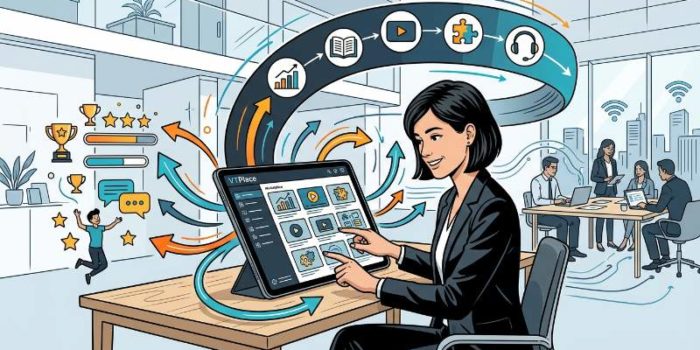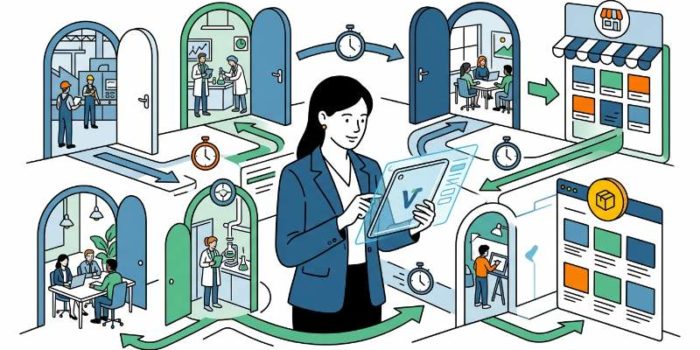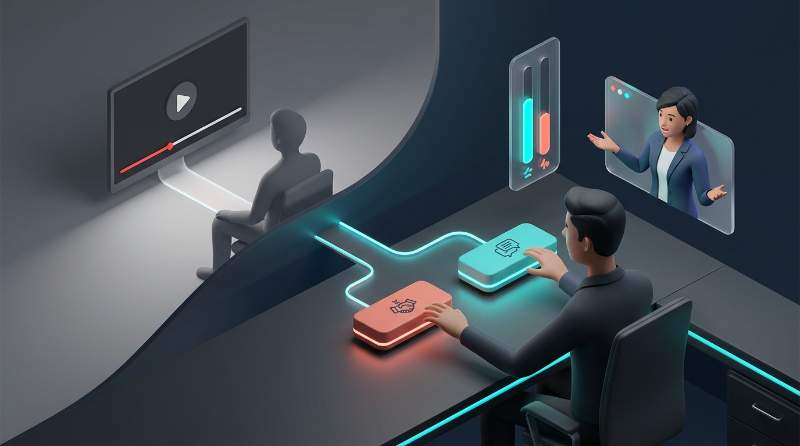
We have all seen this or even done it ourselves: a training video running in the background on a second screen while we reply to emails. This is the issue with passive video. It is expensive to produce, and the impact on the ground is often invisible. Watching a screen without taking action does not develop skills. This is exactly where **L&D interactive video** comes in. The idea is simple: we stop letting images scroll by passively. The learner takes control, makes choices, makes mistakes, and immediately sees the consequences of their decisions on the scenario.
Why Traditional Video is Giving Way to L&D Interactive Video
L&D Interactive Video Against the Illusion of Passive Learning
We tend to believe that watching an expert is enough to learn how to do something. In reality, when facing an inactive screen, attention drops within three minutes. A 2004 study by researchers Schwan and Riempp, published in Learning and Instruction under the title The cognitive benefits of interactive videos, shows that user control over the video stream significantly improves skill acquisition compared to linear viewing. This makes perfect sense: our brains retain what we manipulate, not what we politely watch.
Take cybersecurity as an example. You have someone watch a standard video about phishing. The learner clicks next, completes the module, and that’s it. Two weeks later, they receive a highly convincing fake phishing email. Under the pressure of a busy workday, they click. Why? Because they memorized a theoretical rule in the back of their mind, but they did not develop the right reflexes in the field. Without real-world practice and immediate feedback, theory evaporates. To solve this, learning by doing remains the most reliable method.
The Logistical and Financial Burden of Video Shoots
If you have ever managed an L&D project, you know the drill. Organizing a traditional video shoot is an uphill battle.
First, it is discouragingly slow. Writing the script, finding actors, booking locations, and editing easily takes three to four months for just ten minutes of useful video. By the time the module goes live, your processes or offerings have already changed.
Second, let’s talk budget. Agency quotes quickly spiral into tens of thousands of dollars. With rates like these, you have to limit yourself to so-called priority topics. What about the rest of your teams? They wait.
Finally, these videos are frozen. If a procedure changes, you have to re-record everything, head back to the studio, and pay again. You quickly end up with an obsolete catalog that you cannot update without extra budget. To optimize your investments, mastering e-learning production costs is essential.
Branching Scenarios: Empowering Learners to Choose
When Learner Choices Drive the Story
Forget the “Next” button. Here, the learner drives the L&D interactive video.
Imagine a retail sales situation. An unhappy customer enters and verbally attacks the sales associate. The video stops. Three options appear:
- You firmly remind them of the general terms of sale.
- You listen calmly without interrupting and reframe their problem.
- You immediately offer a commercial gesture to cut the interaction short.
The learner chooses. If they opt for firmness, the video resumes and the customer gets even angrier. If they choose active listening, the tension drops and dialogue opens up. This right to make mistakes changes everything. It is far better to lose a virtual sale or halt a fake machine during training than to make the same mistake in front of a real customer or on a real production line.
Measuring Skills, Not Memorization Capacity
To be effective, the simulation must match the daily reality of your teams. Overly standardized content fails because it lacks context.
Effectiveness comes from customization: integrating company jargon, your actual machine breakdowns, or the real objections of your most difficult customers. This also marks the end of the traditional quiz at the end of a course. We no longer assess whether someone can recite theory, but whether they know how to act. Feedback is not just a score out of 20, but the direct consequence of their choices within the scenario.
SF Studio: Design Your Interactive Simulations in 15 Days
A Production Pace Built for the Field
Producing high-quality content quickly without working overnight is the exact focus of the SF Studio offering. We combine our design tools and 15 years of expertise in instructional engineering to deliver ready-to-use learning paths. If you prefer to be fully autonomous, the VTS Editor authoring software allows you to create these interactive and gamified scenarios yourself.
Concretely, how do these 15 days work with the SF Studio method?
- Days 1 to 3: Scoping and gathering your business content.
- Days 4 to 7: Our instructional designers write the decision-making scenario.
- Days 8 to 10: We deliver a functional beta version (the decision tree can be tested, even without the final visuals) to validate the learning logic.
- Days 11 to 13: Adjustments and final visual integration.
- Day 15: The module is ready, exported in standard formats (SCORM, xAPI, or Web).
Validating the scenario mechanics before locking in the visuals avoids endless back-and-forth reviews and complex corrections at the end of the project.
Dividing Costs by 7 While Maintaining High Realism
The technology used by SF Studio bypasses the constraints of physical video shoots while delivering an immersive experience.
You can adapt the entire visual environment to your brand identity, from illustrated style to realistic 3D. The backgrounds (workshops, offices, warehouses) and characters are customized to mirror your actual workspaces and field teams.
Financially, the difference is massive. This production model divides costs by 7 compared to a traditional video agency, saving you about 85% of your budget. This means you can address far more operational topics with the same budget.
On the technical side, no headaches: your modules integrate directly into your current LMS or onto our VTS Perform management platform. Your teams can easily access them on PC, tablet, or mobile.
Frequently Asked Questions About L&D Interactive Video
What is the concrete impact on the completion rate?
Interactivity is a game-changer for engagement. Traditional, passive training videos rarely exceed a 30% completion rate. By making learners active participants who control their choices, L&D interactive video regularly achieves completion rates above 90%.
How do I deploy these modules to my current LMS?
It is very simple. The files follow industry standards: SCORM (1.2 and 2004), xAPI, or HTML5. You just drag and drop them into your usual LMS to track progress, employee choices, and time spent.
How long does it take to create a custom module?
Where a traditional agency requires 3 to 4 months of preparation, casting, and editing, the SF Studio method delivers a customized, ready-to-use module in just 15 days, thanks to our internal production tools and instructional expertise.