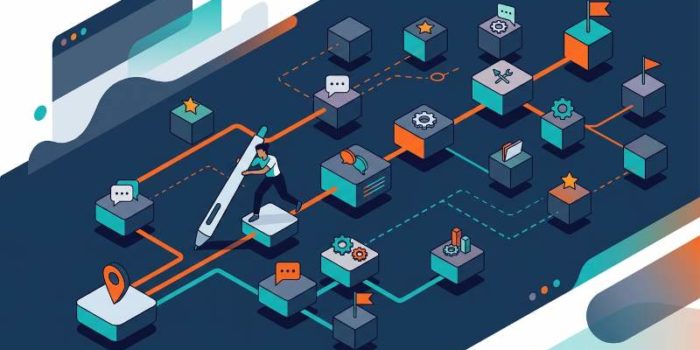
I often see a simple reality in corporate training: delivering top-down information does not change behavior. Learners click, read, and forget. To anchor a professional skill, they must face complex, realistic choices. This is where a branching e-learning scenario comes in. Every decision directly alters the learning path. Employees practice,...
Gamified e-learning refers to an instructional design method that replaces simple information delivery with interactive, scenario-based role-playing centered on decision-making. This approach concretely develops employee skills by confronting them with the realities of their job through operational training. Training directors and instructional designers regularly observe a contradiction on the ground....
An employee completes their e-learning path with a 100% score. The dashboard displays green indicators, confirming screen time and memorization of theoretical concepts. Yet, the very next day, this same employee faces an angry customer or must manage an intense team conflict. In both cases, they make the wrong call....
Making e-learning training action-oriented refers to the instructional design process that transforms the simple dissemination of theoretical information into genuine practical training. To achieve this, you need to design interactive pathways integrating branching scenarios, professional role-play setups, and assessment based on behavioral choices rather than traditional declarative validation. An employee...
The foundations of successful project scoping The serious game specifications document represents a critical step for Learning & Development teams. I regularly observe projects that drift off course because the scoping document focuses on the wrong priorities from the outset. A poorly calibrated brief almost always produces the same operational...
I regularly audit digital learning paths. I systematically observe the same flaw in their instructional design. Knowledge validation is often reduced to a strictly binary approach. The learner submits their choice and is immediately hit with a giant red cross. This signal is accompanied by the classic generic text stating...
Gamification in digital training goes far beyond simply awarding badges or points. It relies on concrete interactive mechanics, such as branching scenarios and role-play simulations. The objective is to confront learners with realistic decisions to turn theoretical knowledge transmission into genuine behavioral practice. Researcher Karl Kapp (The Gamification of Learning...
The pattern on the ground is all too familiar: a module shows a 100% completion rate, the employee has watched every video, clicked through every slide, and scored the bare minimum on the final quiz. On paper, the training is validated. Yet, the operational reality tells a completely different story....
Most corporate e-learning programs hit a recurring glass ceiling. L&D departments fund learning paths that often resemble nothing more than digitized slide decks where learners passively click through screens. The field reality is clear: engagement collapses. Employees complete these modules purely to check a box, without ever building the reflexes...
A new procedure goes into effect. A new tool is rolled out. The company demands immediate adaptation from its teams. In the field, I systematically observe a bottleneck: digital transformation departments struggle with design. Technical and instructional creation time blocks the organization. Creating a custom interactive path takes time. According...